
 EN
EN
 FR
FR DE
DE JA
JA KO
KO RU
RU ES
ES AR
AR IT
IT
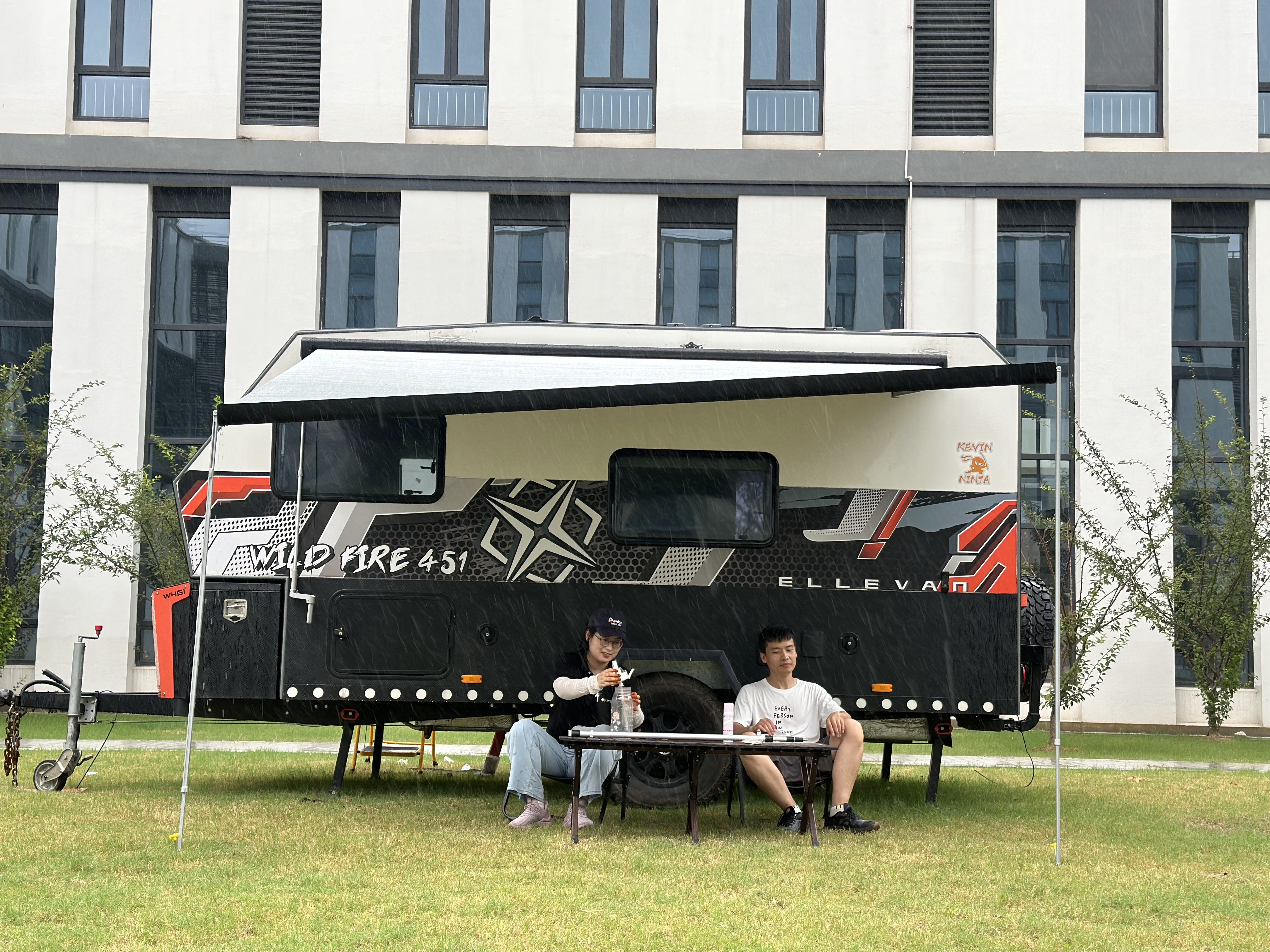
A Reddit user on r/VanLifeUK put it plainly in July 2026: "Just bought our first T6 camper and we are hoping to head out on adventures soon. We are trying to decide between awnings — but nobody talks about how they actually hold up in the rain."
That comment has 47 upvotes. It tells you everything you need to know about the UK awning market.
Britain's camping conditions are unique. The weather changes faster than anywhere else in Europe. A clear Sunday morning in the Lake District can turn into a horizontal rain event by 2pm. The winds along the Scottish coast regularly exceed 30mph. And yet the question most awning guides answer is "which awning looks best?" — not "which awning survives a British summer?"
This guide answers the second question. It is written for UK caravan owners (Bailey, Swift, Coachman, Elddis), campervan builders (VW T6, Ford Transit, Mercedes Sprinter), and anyone who has watched their awning buckle in a Force 5 gust and wondered if there is something better.
Why Choosing an Awning in the UK Is Different from the Rest of Europe
The UK camping market has three characteristics that make awning selection genuinely different from France, Germany, or Australia.
First: the weather is the primary design constraint, not the sunshine.
The average UK camping season runs April to October. During that period, the Met Office records meaningful rainfall on roughly 50% of days across Scotland and northern England. Awning decisions in the UK must start with the question "how does this awning handle rain?" — not "how much shade does this provide?"
Second: British caravans have specific dimensional characteristics.
The UK's most popular caravan brands — Bailey, Swift, Coachman, and Elddis — use construction standards and wall profiles that differ from European motorhomes. Bailey's double-skinned GRP bodywork and Swift's Eco-construction panels have different structural properties at the mounting point. An awning that installs simply on a German Adria may need adapter brackets on a Swift Challenger.
Third: the UK campsite culture favours semi-permanent pitching.
A significant proportion of UK caravan owners pitch at seasonal or long-stay sites, where the awning may remain erected for days or weeks. This changes the performance requirement from "holds up for a day trip" to "survives unattended overnight in changeable conditions." That is a fundamentally harder design brief.
What Are the Main Types of RV Awnings Available in the UK?
Before comparing performance in wet conditions, it helps to understand what you are actually choosing between. The UK market offers three primary vehicle-mounted awning types for RVs and caravans.
Full Cassette Awnings
The fabric, arms, and mechanism are fully enclosed in an aluminium housing (cassette) when retracted. The cassette protects the fabric from UV, bird fouling, and moisture ingress when stored. This is the most widely recommended type for UK conditions and includes products such as the Fiamma F45s and Awnlux W5500/W5510 / W5800/W5810.
Rain performance: Good. The spring tension maintains fabric pitch across the deployed span, reducing pooling risk. Correctly pitched, a cassette awning channels rain off the leading edge reliably.
Wind performance: Better than non-cassette alternatives. The arm geometry of a cassette system provides more consistent structural support along the full deployment length. In sustained winds above 25-30 mph, retraction is still recommended.
Why this matters in the UK: Fabric that stays wet when packed away will develop mould. Full cassette protection eliminates this problem entirely because the fabric is sealed inside the aluminium housing on retraction. For UK owners who frequently pack up in wet conditions, this is not a minor benefit — it is a primary durability consideration.
Roof Mount Awnings
Mounted to the roof rather than the side wall. These are the solution when the van's side wall does not provide adequate mounting area — common on high-roof panel vans, vehicles with rear barn doors close to the roofline, or caravans with unusual body profiles.
UK relevance: The VW T6 high-roof conversion and Ford Transit with roof rack configurations often use roof mount awnings because side wall clearance is limited. The Thule Omnistor 6300 is the most commonly referenced option in this category in the UK market.
Drive-Away / Tunnel Awnings
A detachable ground-level awning that connects to the van and can remain on-site when the vehicle drives away. Extremely popular with UK caravan owners for seasonal pitching. This guide focuses on vehicle-mounted awnings (cassette and roof-mount) rather than drive-away designs, which are a separate product category.
What Wind Speed Is Safe for a UK RV Awning?
This is the question UK campers search for most — and most awning guides avoid answering directly.
Direct answer: most vehicle-mounted awnings should be retracted in sustained winds above 20-25 mph (Beaufort Force 4-5).
The UK Met Office classifies Force 4 as "moderate breeze" (13-18 mph) and Force 5 as "fresh breeze" (19-24 mph). At Force 5, small trees begin to sway. This is the wind speed at which most awning arm systems begin to experience meaningful structural load.
The practical implication: if you are camping in exposed locations — coastal sites, moorland, Scottish Highlands — an awning that requires manual retraction at Force 5 is one that will frequently need to come down. Motorhomefun.co.uk users consistently report the same experience: "I never put mine out in anything above a gentle breeze. Have seen too many damaged."
Engineering Note: The structural weakness in most awnings under wind load is not the fabric — it is the arm hinge mechanism. Arms designed for smooth, low-friction deployment are often optimised for elegance rather than resistance to lateral wind load. A pneumatic gas strut arm (as used on higher-specification motorised cassette awnings) maintains consistent tension along the arm length and resists oscillation significantly better than a basic spring-hinge design. This is a meaningful engineering difference, not a marketing distinction.
Smart awning systems with integrated wind sensors address this differently: rather than relying on the owner to retract in time, an embedded vibration sensor and algorithm detects sustained wind load and automatically retracts the awning within seconds of reaching the threshold. For UK owners pitching in exposed locations or leaving awnings unattended, this represents a genuine safety improvement over manual retraction.
How Do You Stop an RV Awning from Pooling Water in Rain?
Water pooling is the most common UK camping complaint about awnings. It happens when rain accumulates in the centre of the fabric, creating a heavy sag that stresses the arm joints and, in severe cases, collapses the entire awning.
The fix is simple but not always obvious: pitch angle.
Every vehicle-mounted awning should be deployed with a deliberate forward pitch — lowering the outer edge of the leading arm by 10-15cm creates a slope that channels water off the front edge rather than allowing it to pool in the centre.
Step-by-step for vehicle-mounted cassette awnings:
1. Deploy the awning fully and lock both arms in the extended position
2. Lower the leading arm on the rain-drainage side (usually the side away from the door) by releasing the height adjustment and repositioning the support leg
3. A pitch angle of approximately 5-8 degrees is sufficient for normal UK rainfall
4. In heavy rain, check periodically and manually encourage any pooled water toward the lower edge with a broom handle or pole
When pooling persists despite correct pitch:
If water pools even with a proper drainage angle, the cause is usually fabric sag from insufficient spring tension. The solution is to increase the tension on the roller tube spring — turning the adjustment mechanism clockwise (viewed from the right end) by 1-2 increments. This restores the fabric to full tension and prevents central sagging under rain load.
For full cassette awnings, the enclosed cassette design additionally protects the roller spring mechanism from moisture ingress, which preserves spring performance over multiple seasons.
Which Awning Types Are Best for British Caravans (Bailey, Swift, Coachman)?
British touring caravans present specific installation considerations. The "Big Three" — Bailey, Swift, and Coachman — account for the majority of UK caravan registrations and each has characteristics that affect awning selection.
|
Brand |
Body Construction |
Key Awning Consideration |
|
Bailey |
Double-skinned GRP (Alu-Tech) |
Robust wall structure; standard wall-mount awning fits well; confirm rail channel compatibility |
|
Swift |
Eco-construction composite panel |
Lighter construction; verify mounting point load capacity before selecting large/heavy cassette awnings |
|
Coachman |
Timber frame with composite cladding |
Traditional construction; standard mounting; good compatibility with wall-mount systems |
|
Elddis |
Steel frame with composite panels |
Standard wall-mount compatible; check for body indentations near intended mount position |
For British caravan owners, the full cassette awning offers an important practical advantage: when you pack up in the rain (which will happen in the UK), the cassette seals the wet fabric inside the aluminium housing. The fabric cannot mould or mildew in storage the way an open-style fabric can when packed away damp, because it has no air contact. For a caravan that may be stored for weeks between uses, this is a meaningful durability difference.
What Are the Most Popular Awning Choices in the UK — and What Do Users Actually Say?
Fiamma F45s: The most frequently referenced van awning in UK forums. Owners on T6Forum.com report it "holds up to harsher wind conditions than I ever would have imagined" when properly configured with rafter poles and side rails. However, users consistently note that it requires full accessory kit (3 rafter poles, 2 side rails, storm straps) to perform well in British weather — the bare awning without these additions is described as "paranoia-inducing in the rain." Price point for a fully equipped F45s setup in the UK typically reaches £800-£1,100.
Thule Omnistor 6300: The benchmark for roof-mount installations in Europe. Well-regarded for build quality and clean aesthetics. No motorised smart version; no solar integration option. Widely available through UK caravan dealers.
OLPRO: A UK-specific brand with growing presence. Uses dual beading system for van compatibility across multiple models. More competitively priced than Fiamma or Thule but with less brand recognition in motorhome communities.
Where the gap is: None of the commonly available UK awnings offer an integrated solar generation option. For the growing segment of UK campers moving toward off-grid and hybrid camping — particularly relevant as UK campsite electrical hook-up costs have risen — an awning that generates power while providing shade represents a capability gap that currently has almost no product coverage in the UK market.
Awnlux W5510 and W5810: What Makes Them Relevant for UK Conditions
Awnlux has supplied awning systems to partners across Europe, including established distributors in Germany and the Netherlands, for over a decade. The W5510 and W5810 series were specifically developed with European market requirements in mind, including the lighter chassis construction common to European caravans and the integrated COB lighting that European buyers consistently prioritise.
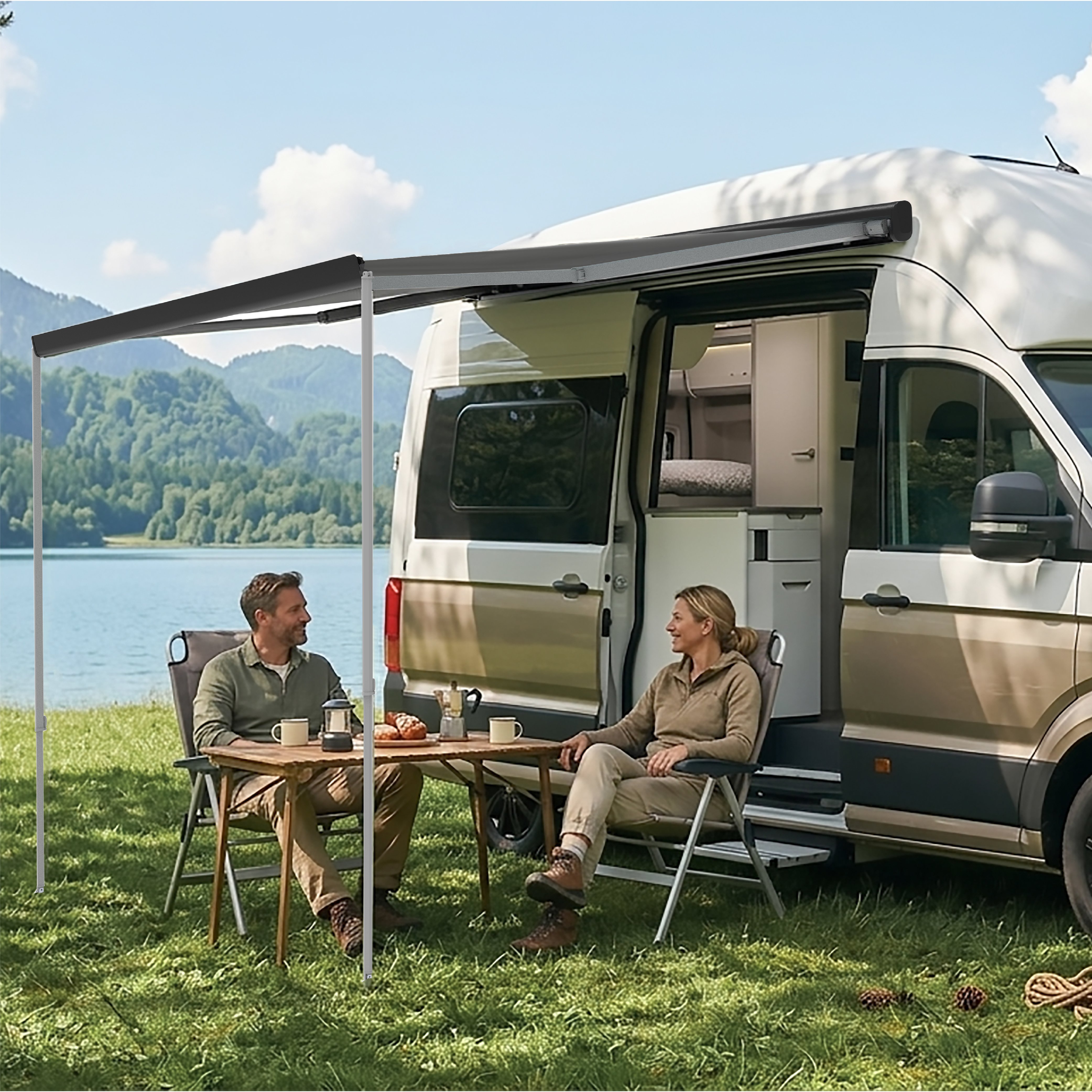
W5510 (European Wall Mount, Full Cassette):
- Available widths: 150-400cm — covers the full range of UK caravan and campervan applications
- Frame material: 6063-T5 aluminium alloy (yield strength 145 MPa; natural salt-corrosion resistance — relevant for UK coastal camping)
- Motor option: 12V DC with IP67 waterproof rating (fully submersible-standard; performs in sustained rain)
- Cassette design: fully enclosed aluminium housing seals fabric on retraction — directly addresses the UK wet-pack problem
- Integrated COB lighting option available
-
Smart control system:Three control modes in a single unit — local wall panel, smartphone Bluetooth app, and vehicle head unit integration.
-
Wind protection system (optional):An external wind sensor can be added to the W5510 motorised unit. The sensor continuously monitors wind load and triggers automatic retraction when the threshold is reached — without any input from the owner. For UK owners pitching in exposed coastal or moorland locations, this removes the single most common cause of awning damage: failing to retract before a wind event escalates.
W5810 (European Roof Mount, Full Cassette):
- For vehicles where side-wall mounting is not possible
- Width range: 200-400cm
- Same 6063-T5 aluminium construction and IP67 motor specification
- Particularly relevant for UK high-roof panel van conversions and caravans with restricted side-wall mounting space
On wind performance: Both models use a fabric and arm geometry designed for European conditions. The IP67 motor rating means the electric drive continues functioning in rain without moisture ingress risk — a failure point that lower-rated motors (IP44 standard) are susceptible to in sustained wet conditions.
A Practical UK Awning Selection Framework
In the UK and across Europe, the vast majority of campervan and caravan owners choose a full cassette awning — the sealed aluminium housing protects the fabric from UV, moisture, and fouling whether the vehicle is in use or stored. Use the three-part guide below to identify the right configuration for your vehicle and camping style.
Option 1: Full Cassette Side-Mount Awning
Best for: Touring caravans (Bailey, Swift, Coachman, Elddis), motorhomes, and campervans (VW T6/T5, Ford Transit, Sprinter) where the side wall provides adequate flat mounting area.
A side-mount cassette awning attaches to the vehicle wall. The aluminium cassette housing sits flush against the wall when closed, sealing the fabric, arms, and mechanism entirely. When deployed, the arms extend outward to create a covered outdoor area.
Key selection points for UK conditions:
Manual vs motorised:
- Motorised with wind sensor is strongly recommended for UK owners who pitch in exposed locations or leave the awning deployed without direct supervision. The wind sensor automatically triggers retraction at a pre-set threshold — eliminating the risk of storm damage overnight
Motor rating:
- Specify IP67 minimum. The UK's sustained rain events mean a motor rated only to IP44 (splash-proof) is exposed to real ingress risk over time
Frame material:
- 6063-T5 aluminium provides natural salt-air corrosion resistance — relevant for coastal pitching in Cornwall, the Scottish islands, and Wales
Typical sizes:
- 150-400cm width covers the full range of UK caravan and campervan side-wall lengths
Vehicle compatibility note: Confirm mounting rail channel dimensions with your caravan manufacturer before ordering. Swift's Eco-construction composite panels and Bailey's Alu-Tech GRP bodywork have different structural ratings at the wall-mount point — check the maximum permitted load before selecting a heavy cassette unit.
Representative products: Fiamma F45s, Awnlux W5510,Awnlux W5500
Option 2: Full Cassette Roof-Mount Awning
Best for: High-roof panel van conversions, vehicles where side-wall space is restricted by windows, doors, or solar panels, and campervans where a flush roof profile is preferred over a side-wall bracket.
A roof-mount cassette awning is fixed to the roof surface rather than the side wall. The cassette sits low-profile on the roof when closed. When deployed, the awning extends outward and downward from the roof edge, providing the same covered outdoor area as a side-mount.
When to choose roof-mount over side-mount:
- Side wall does not offer a continuous flat run of 150cm or more for mounting
- Vehicle has rear barn doors positioned close to the roofline that would conflict with a side-mount bracket
- High-roof Transit or Sprinter conversions where the roofline offers a cleaner structural attachment point than the curved upper side wall
- Preference for a lower profile when the vehicle is parked — roof-mount cassettes are less visually prominent than side-mount housings
Key selection points:
- Verify the roof structure can accept the static load of the awning plus wind load when deployed. Roof-mount awnings transfer forces differently from side-mount systems
- Waterproofing at the mounting points is critical — all fixing holes must be sealed with neutral-cure silicone on a roof installation to prevent water ingress into the vehicle interior
- Motorised option with IP67 motor rating is equally relevant for UK roof-mount installations
Representative products: Thule Omnistor 6300, Awnlux W5810
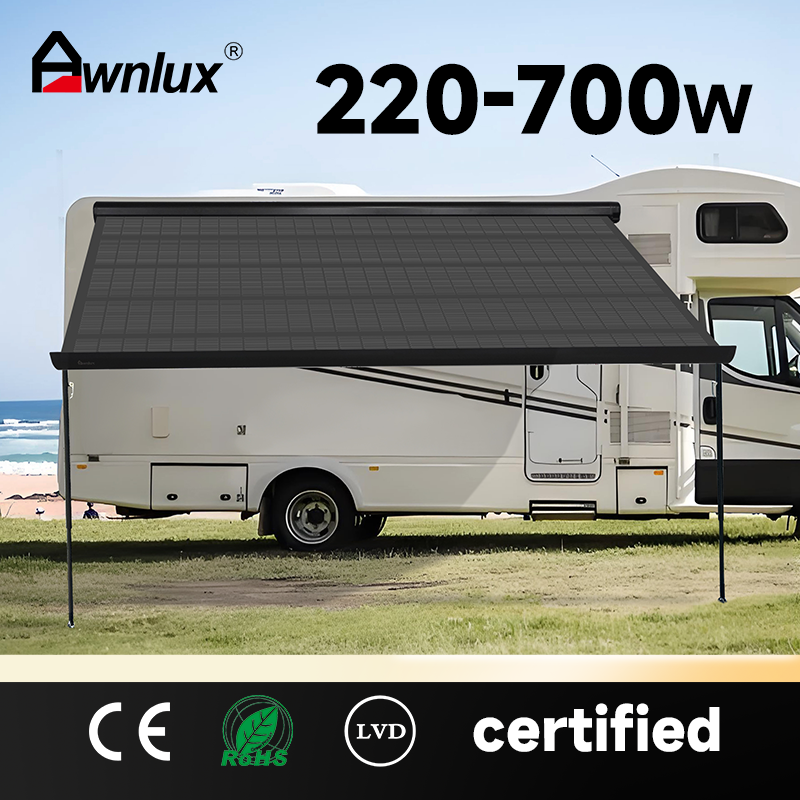
Option 3: Solar-Integrated Full Cassette Awning (CIGS)
Best for: UK owners moving toward off-grid or reduced hook-up camping, campervans with high electrical demand (compressor fridge, lighting, device charging), and anyone who currently runs a separate roof solar panel installation and wants to consolidate.
A CIGS solar-integrated awning combines the full cassette mechanism with a flexible thin-film photovoltaic layer embedded in the fabric. The awning generates electricity whenever it is deployed in daylight — including in the overcast and diffuse light conditions typical of a British summer.
Why CIGS specifically for UK conditions:
- CIGS (Copper Indium Gallium Selenide) thin-film technology maintains meaningful output under diffuse and overcast light, unlike monocrystalline silicon panels which drop sharply in shade or cloud cover
- The flexible film is integral to the fabric — it rolls up with the cassette mechanism without cracking or delaminating, a failure mode that rigid panels cannot tolerate
- Weight: CIGS fabric weighs approximately 1.3 kg/m², significantly lighter than rigid solar panels, which is relevant for roof-load calculations on lighter van conversions
UK power generation reality: Southern England averages 4-5 hours of effective solar irradiance per day during the camping season (April-October). Scotland and northern England average 3-4 hours. A 3m² CIGS awning generating 100W/m² under standard conditions produces approximately 1.2-1.5kWh per day in southern England — sufficient for a 12V compressor fridge, LED lighting, and full device charging without hook-up. Pairing with a 100Ah LiFePO4 battery provides 2-3 days of autonomy in mixed weather.
Important: CIGS solar fabric is integrated into a specialist cassette frame system. It cannot be retrofitted to a standard awning frame — the structural load requirements differ from conventional awning fabric. Specify a solar-integrated system from the outset rather than attempting to add solar capability to an existing awning.
Representative products: Awnlux SOLARAWN SA5900
Frequently Asked Questions
Q: What wind speed should I retract my UK caravan awning? A: Most manufacturers and experienced UK campers recommend retraction at sustained winds above 20-25 mph (Beaufort Force 4-5). At Force 5, small trees begin to sway — that is your visual cue. Smart awnings with wind sensors automate this; standard awnings require the owner to act. Do not rely on the fabric to tell you — arm joint damage typically precedes visible fabric failure.
Q: How do I stop my caravan awning from pooling water in heavy rain? A: Lower the outer leading arm by 10-15cm to create a forward drainage pitch. For persistent pooling, increase roller tube spring tension by 1-2 clockwise increments. Full cassette awnings with sufficient spring tension rarely pool because the fabric is maintained under consistent tension.
Q: Can I mount a wall awning on a Swift or Bailey caravan? A: Yes, with caveats. Confirm the mounting rail channel dimensions match the awning's bracket specification. Swift's Eco-construction panels are lighter than traditional timber-frame bodies — check the awning's weight specification and the caravan manufacturer's maximum wall-mount load rating before selecting a heavy cassette unit.
Q: Is a full cassette awning worth the extra cost for UK camping? A: For UK conditions specifically — yes. The sealed cassette prevents the wet-fabric mould problem that affects open-style awnings packed up in rain. Over a 3-5 year ownership period, the fabric durability difference justifies the price premium for owners who camp regularly.
Q: Is the Fiamma F45s good for UK rain and wind? A: It performs well when fully accessorised (rafter poles, side rails, storm straps). Without the full accessory kit, UK users consistently report anxiety in rain and wind. Budget for the complete system, not just the awning, when comparing prices. Bare F45s plus full UK weather accessory kit typically costs £800-£1,100.
Final Thought
The UK camping market does not need more awning guides that describe how something looks in sunshine. It needs honest guidance on what survives a wet August bank holiday weekend in Wales — and what does not.
The answer, consistently, comes down to three things: full cassette construction for fabric preservation, correct pitch angle for rain drainage, and an honest wind speed limit that the owner actually respects. Smart retraction systems that automate that last point are increasingly worth considering for anyone who pitches in exposed locations or leaves an awning deployed overnight.
If you are assessing options for a British caravan or campervan build and want technical specifications on awning load ratings, bracket compatibility, or motor waterproofing standards, the Awnlux team is available for direct consultation. Our engineers have 16 years of awning manufacturing experience and supply systems to European distribution partners.
Technical References
- Met Office Beaufort Scale (UK wind speed classification)
- IEC 60529 — IP waterproofing rating standard (IP67 specification)
- ASTM B221 — 6063-T5 aluminium alloy mechanical properties
- Reddit r/VanLifeUK — July 2026 awning discussion thread
- T6Forum.com — Fiamma F45s wind and rain performance thread (2024)
- MotorHomeFun.co.uk — awning wind speed community discussion
- Practical Caravan UK — Best Caravans 2026 guide
Published: July 2026 | Category: Buyer's Guide, UK Market, Technical | Author: Awnlux Engineering Team
Get in touch
Table of Contents
- Why Choosing an Awning in the UK Is Different from the Rest of Europe
- What Are the Main Types of RV Awnings Available in the UK?
- What Wind Speed Is Safe for a UK RV Awning?
- How Do You Stop an RV Awning from Pooling Water in Rain?
- Which Awning Types Are Best for British Caravans (Bailey, Swift, Coachman)?
- What Are the Most Popular Awning Choices in the UK — and What Do Users Actually Say?
- Awnlux W5510 and W5810: What Makes Them Relevant for UK Conditions
- A Practical UK Awning Selection Framework
- Frequently Asked Questions
- Final Thought
- Technical References