
 EN
EN
 FR
FR DE
DE JA
JA KO
KO RU
RU ES
ES AR
AR IT
IT
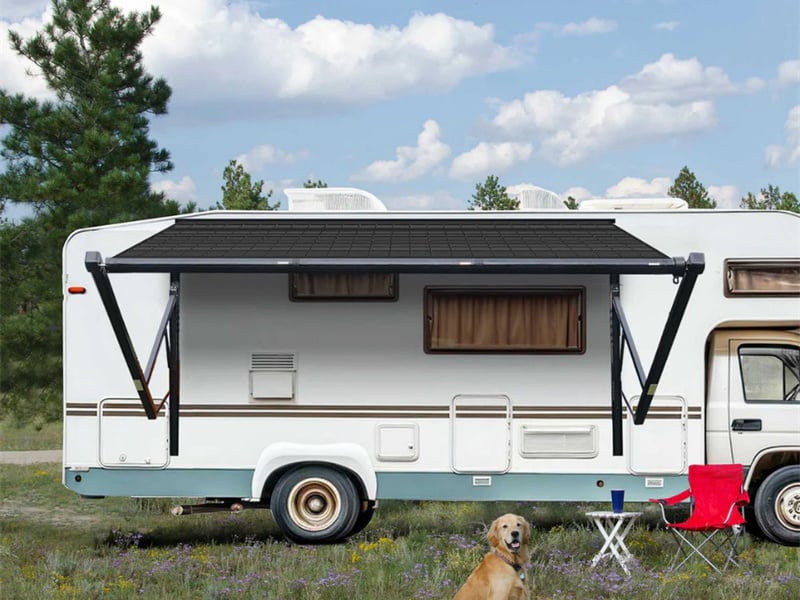
How CIGS Thin-Film Technology Turns RV Shade into Off-Grid Power
1. What Is a Solar Awning?
A solar awning is an upgraded version of the traditional RV awning, seamlessly combining flexible photovoltaic (PV) fabric with essential shade protection. While blocking sunlight and extending your outdoor living space, it continuously generates electricity—without taking up valuable roof space or requiring additional roof drilling.
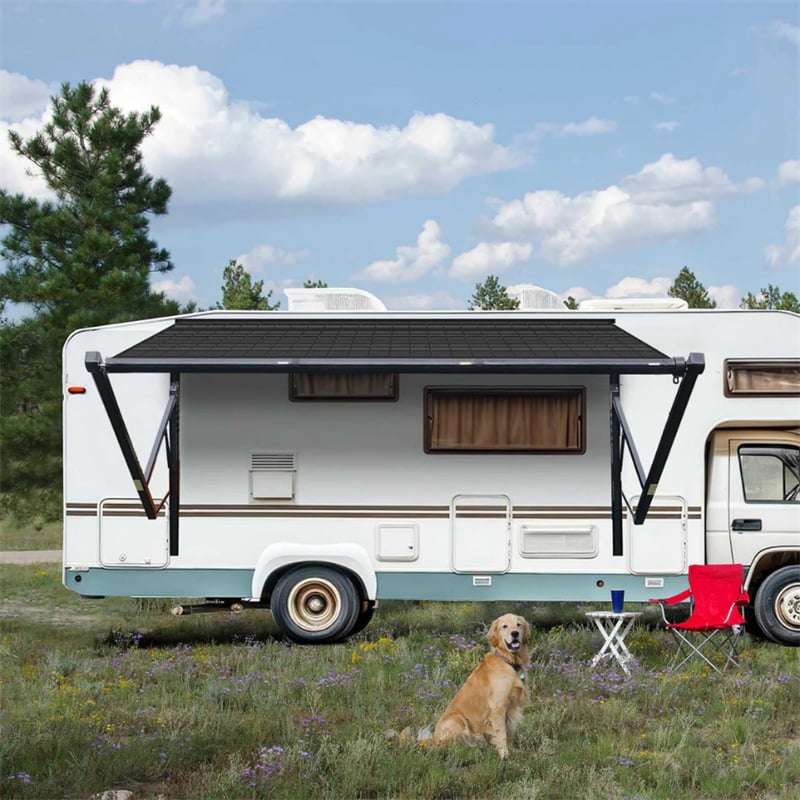
When deployed, it charges your RV's house battery bank, lowers interior temperatures, and reduces air conditioning energy consumption. Compared to standard awnings, it strikes a perfect balance between practicality and energy efficiency. By delivering steady daytime power, it effectively eliminates off-grid power anxiety. When paired with an energy storage system, it easily powers daily electronics, lighting, refrigeration, and appliances, making it an ideal upgrade for RV road trips and off-grid camping.
2. Why Develop Solar Awnings? (Core Drivers)
A. Solving Two Major RV Pain Points
- Power Anxiety: Off-grid appliances like refrigerators, air conditioners, lights, water pumps, and induction cooktops consume significant power. Traditional rooftop solar is often limited by space and output. Generators, on the other hand, are noisy, fuel-thirsty, high-maintenance, and polluting.
- Space Constraints: RV roofs are often crowded with AC units, skylights, vents, and storage boxes, leaving little room for extra solar panels. Meanwhile, traditional awnings provide shade but leave a vast surface area completely unutilized for energy collection.
B. Technology & Scenario Drivers
- Mature Flexible PV: CIGS and HJT flexible solar panels are lightweight, rollable, and highly durable under bending stress. Integrating them into awning fabric enables a true "shade-is-power" solution.
- Exploding Off-Grid Demand: As RVers move away from commercial RV parks toward boondocking, users demand a continuous, clean, and cost-effective independent power source.
- Cost Savings & Efficiency: Combining two products into one replaces the need for separate traditional awnings and secondary rooftop solar setups, significantly reducing installation, accessory, and maintenance costs.
C. Safety & User Experience Upgrades
- Traditional rooftop solar panels are heavy, complex to install, increase leak risks, and pose potential safety hazards at highway speeds. Solar awnings are lightweight, preserve roof integrity, and retract safely.
- Generating power while shading your RV creates a virtuous cycle: Shade Lower Interior Temp Reduced AC Usage Extra Power Generation.
3. Solar Awning vs. Traditional RV Awning
A. Core Comparison Table
|
Feature / Dimension |
Traditional RV Awning |
Solar Awning |
|
Core Function |
Shade, light rain shelter, outdoor extension |
Shade + Power Generation + Optional Self-Powered LED / Motorized Retraction |
|
Space Utilization |
Large surface area goes unutilized |
Shade area = Power generation area (Zero additional space footprint) |
|
Energy Contribution |
None (Electric models actually consume RV battery power) |
5–15 area; 300–1400W output; 1.1–5.8 kWh/day daily yield |
B. Installation & Structure
- Traditional: Purely mechanical or motorized shade structure. Adding rooftop solar requires drilling, sealing, and complex wiring, which increases the risk of roof leaks.
- Solar: Flexible PV panels are integrated directly into the fabric. It directly replaces existing awnings without drilling into the roof, making wiring cleaner and simpler.
C. Cost & Long-Term Return
- Upfront Cost: Traditional models typically cost around USD $300–$500, while solar awnings range from RMB ¥2,000–¥4,000 (roughly 6–8$\times$ higher upfront).
- Long-Term Return: Solar awnings save on fuel for generators, campsite hookup fees, and battery wear. Based on 100 days of annual off-grid use, a solar awning can save approximately USD $1,100 per year in combined fuel, campsite power, and battery preservation costs.
- Payback Period: For users traveling 100+ days annually, payback is typically achieved in 2–4 years.
D. Best Use Cases
- Traditional: Commercial RV parks, short trips, and setups with grid hookups.
- Solar: Boondocking, long-distance overlanding, off-grid camping, and especially Class B RVs with tight roof space.
4. What Solar Technology Powers These Awnings?
Solar awnings leverage CIGS thin-film technology (), a leading route in high-efficiency flexible photovoltaics. CIGS uses an ultra-thin quaternary compound semiconductor layer to absorb light and generate electricity.
- Core Structure: Flexible or glass substrate Molybdenum (Mo) back contact CIGS absorber layer (only 1–3 , compared to 150–200 for crystalline silicon) Buffer layer Window layer.
- Working Principle: Photons excite electrons in the CIGS layer to create electron-hole pairs, which are separated by the PN junction to produce current. Performance in low light and high heat far exceeds traditional crystalline silicon.
- Market Position: The premier choice for flexible photovoltaics, perfectly suited for RV awnings, BIPV (Building-Integrated Photovoltaics), and portable power gear.
5. Key Advantages of CIGS Technology
A. Superior Low-Light & High-Temperature Performance
With a temperature coefficient of approximately -0.3%/°C (compared to -0.45%/°C for crystalline silicon), CIGS generates 10–20% more daily yield on cloudy days, early mornings, and late afternoons than silicon panels of equivalent wattage.
B. High Flexibility for Frequent Rolling & Retraction
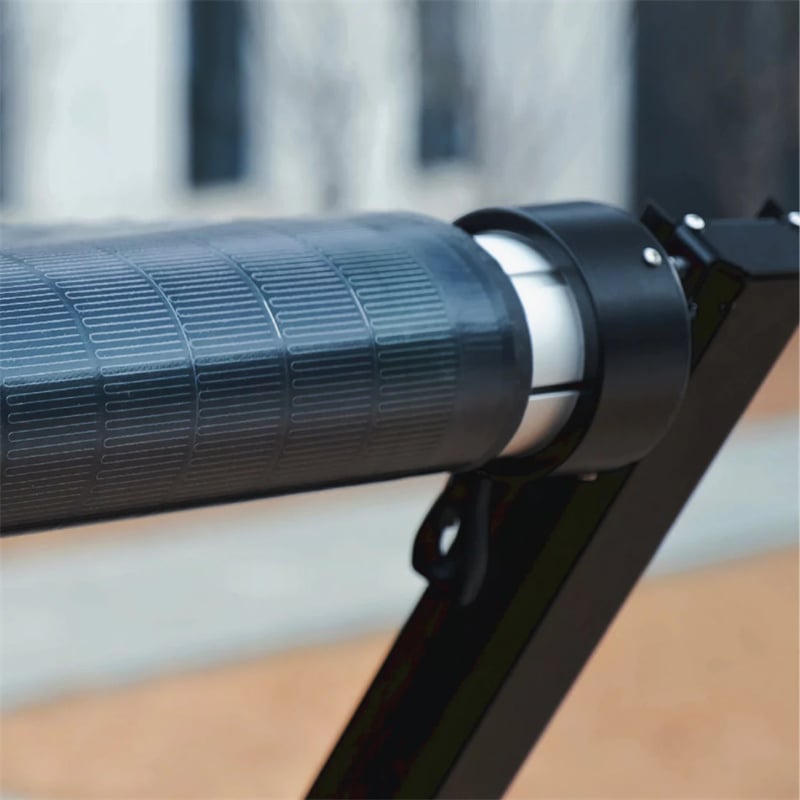
Traditional silicon panels act like fragile, rigid wafers; even when marketed as "flexible," repeated bending causes micro-cracks over time. CIGS operates as a continuous thin film bonded to fabric, easily enduring the mechanical stress of repeated rolling and retraction.
C. Outstanding Partial Shading Tolerance
Camping outdoors means partial shade is inevitable. Tree branches, leaves, dust, and roof AC units cast constant shadows over parts of the awning. Under 30% partial shade (e.g., under trees), CIGS retains 72% of its power output, whereas traditional crystalline silicon drops to just 15%.
D. Ultralight Design
CIGS solar fabric features an areal density of approximately 1.3 , compared to 2.3 for flexible silicon panels—a 43% weight reduction. On a standard awning, this saves roughly 10 kg (22 lbs).
6. Is a Solar Awning Right for You?
Ideal For:
- RVers who frequently boondock or off-grid camp and need reliable battery replenishment.
- RVs with crowded roofs occupied by ACs, vents, skylights, or existing panels.
- Travelers who open their awning often and want that surface area to work double duty.
- Full-time RVers or extended long-term campers.
- Users camping in imperfect lighting conditions (shade, overcast skies, low-angle sun).
- Anyone looking to expand solar collection area without adding permanent roof hardware.
May Not Be Ideal For:
- RVers who almost exclusively stay at commercial parks with full shore-power hookups.
- Campers who rarely extend their awning.
- Travelers who camp in extreme high-wind environments where awnings must stay retracted.
- Budget shoppers looking for the cheapest possible basic solar setup.
7. The True Value of a Solar Awning
A solar awning isn't meant to completely replace rooftop solar—it transforms previously single-use shade space into an active energy harvesting array.
The challenge isn't just sticking solar cells on fabric; it's engineering a cohesive, lightweight system that withstands continuous retraction, extreme weather, and regular use as a durable awning.
Industry Spotlight: Awnlux
As a global leader in RV awnings, Awnlux serves as the technical benchmark in solar awning innovation. By pioneering the integration of flexible CIGS thin-film PV with premium awning textiles, Awnlux solved longstanding engineering challenges related to fabric rollability and outdoor weatherproofing.
Awnlux solar awnings deliver dual functionality—shading your space while capturing clean energy. Their superior low-light yield and high-temp efficiency lower interior temps, cut AC draw, and solve off-grid power anxiety from both energy-generation and energy-saving fronts. Supported by extensive patents, easy installation, and strong distribution networks across Europe (Germany, Netherlands) and Australia, Awnlux continues to lead the industry toward smart, solar-powered shade solutions.
Contact & Info
- Website: www.awnlux.com
- Shop: www.awnluxpro.com
- Direct Links:
- Email: [email protected]
- Phone: +86-21-57793893
Get in touch
Table of Contents
- How CIGS Thin-Film Technology Turns RV Shade into Off-Grid Power
- 2. Why Develop Solar Awnings? (Core Drivers)
- 3. Solar Awning vs. Traditional RV Awning
- 4. What Solar Technology Powers These Awnings?
- 5. Key Advantages of CIGS Technology
- 6. Is a Solar Awning Right for You?
- 7. The True Value of a Solar Awning