
 EN
EN
 FR
FR DE
DE JA
JA KO
KO RU
RU ES
ES AR
AR IT
IT

A Real-World Power Output Analysis of the Awnlux SA5900 Flexible CIGS Solar RV Awning
Introduction: How Solar RV Awnings Are Transforming Off-Grid Camping
As RV travel, van life, and off-grid camping continue to gain popularity worldwide, more travelers are looking for ways to reduce their dependence on shore power and enjoy greater energy independence wherever they go. A reliable solar power system has become an essential part of modern RV living.
Traditional RV solar panels are typically mounted on the roof. However, available roof space is often limited by air conditioners, roof vents, skylights, satellite antennas, luggage racks, and other accessories. These obstacles restrict the installation area and reduce the overall solar energy that can be generated.
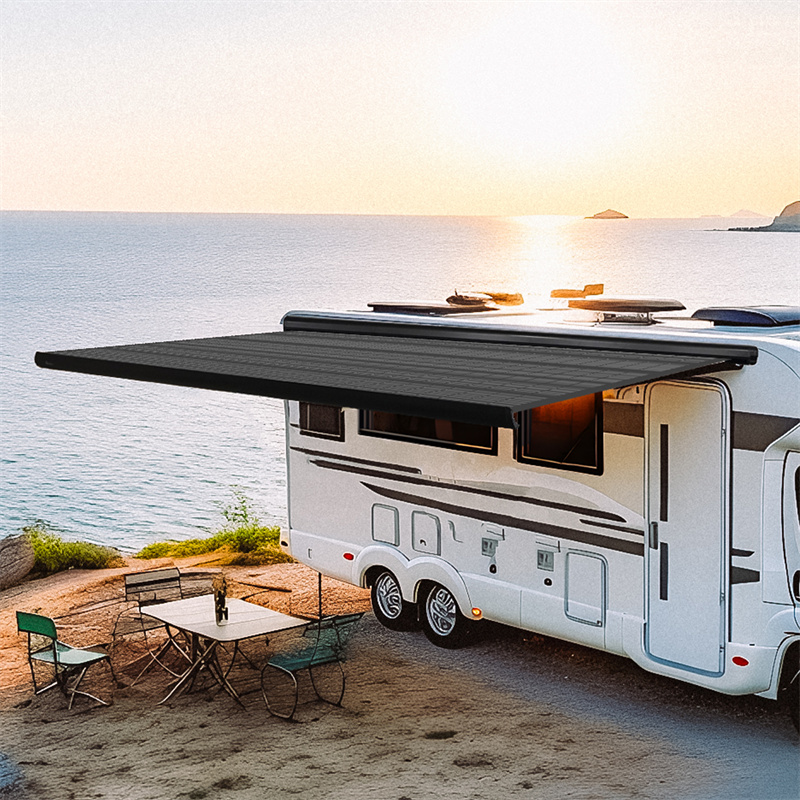
A solar RV awning offers a smarter alternative by combining a retractable awning with a solar power generation system. When deployed, the awning not only creates a comfortable shaded outdoor living space but also transforms its large surface area into an efficient renewable energy platform capable of generating electricity throughout the day.
One of the most common questions from RV owners is:
Can a solar awning generate enough electricity to power an RV refrigerator, LED lights, mobile devices, camping equipment, or even small household appliances?
In this article, we'll use the Awnlux SA5900 Flexible CIGS Solar RV Awning as a real-world example. Based on verified technical specifications and practical camping scenarios, we'll calculate its actual daily energy production and help you determine whether a solar-powered RV awning can meet your off-grid power needs.
How Is Solar RV Awning Power Output Calculated? -Key Factors That Affect Solar RV Awning Energy Generation
The actual energy output of a solar RV awning is not determined by its rated power alone. Instead, it depends on several factors, including the solar collection area, peak sun hours, installation conditions, weather, and the overall efficiency of the solar power system.
The basic calculation is:
Daily Energy Output (Wh) = Rated Solar Power (W) × Peak Sun Hours (h) × System Efficiency
Understanding these three variables will help you estimate how much electricity a solar-powered RV awning can realistically generate during everyday camping.
1. Rated Solar Power Depends on the Effective Solar Collection Area
The rated output of a solar awning is primarily determined by the total area covered by its solar cells. Formula: Rated Solar Power = Effective Solar Area × Power Density (W/m²)
The Awnlux SA5900 utilizes flexible CIGS thin-film solar technology, delivering a power density of 90–120 W/m². For practical calculations, 100 W/m² serves as a reliable reference value.
For example, if an SA5900 solar awning provides an effective solar collection area of 2.5 m × 2.0 m (5 m²): 5 m² × 100 W/m² = 500 W Peak Output
This means the awning can theoretically generate up to 500 watts of solar power under ideal sunlight conditions.
2. Peak Sun Hours Have a Major Impact on Daily Energy Production
A solar system does not operate at its maximum output throughout the entire day. Instead, energy generation depends on the number of Peak Sun Hours (PSH)—the equivalent hours of full solar irradiance received each day.
Typical Peak Sun Hours include:
- Summer (clear skies): approximately 4–6 hours
- Spring and Autumn: approximately 3–5 hours
- Cloudy weather or high-latitude regions: often less than 3 hours
As a result, the same solar RV awning can produce significantly different amounts of electricity depending on the location and season.
For example, regions such as Arizona (USA) and the Australian Outback receive abundant solar radiation, allowing higher daily energy production. In contrast, countries like Germany and the Netherlands experience more variable weather, making it beneficial to pair a solar awning with a battery storage system for more consistent off-grid power management.
3. System Efficiency Determines Real-World Performance
Although rated power is calculated under ideal laboratory conditions, real-world performance is influenced by the overall efficiency of the solar energy system.
In practice, total system efficiency typically ranges from 70% to 85%, depending on factors such as:
- High ambient temperatures
- Solar charge controller conversion losses
- Battery charging efficiency
- Cable and wiring losses
For this reason, the actual energy output of a solar awning should be estimated using realistic system efficiency rather than the theoretical peak power.
Using practical efficiency values provides a far more accurate expectation of how much electricity your RV solar awning can generate during everyday off-grid camping, helping you better plan your vehicle's energy usage.
Real-World Power Output of the Awnlux SA5900 and Typical RV Energy Demands
To better understand how much electricity a solar RV awning can actually generate, let's use the Awnlux SA5900 Flexible CIGS Solar Awning as an example.
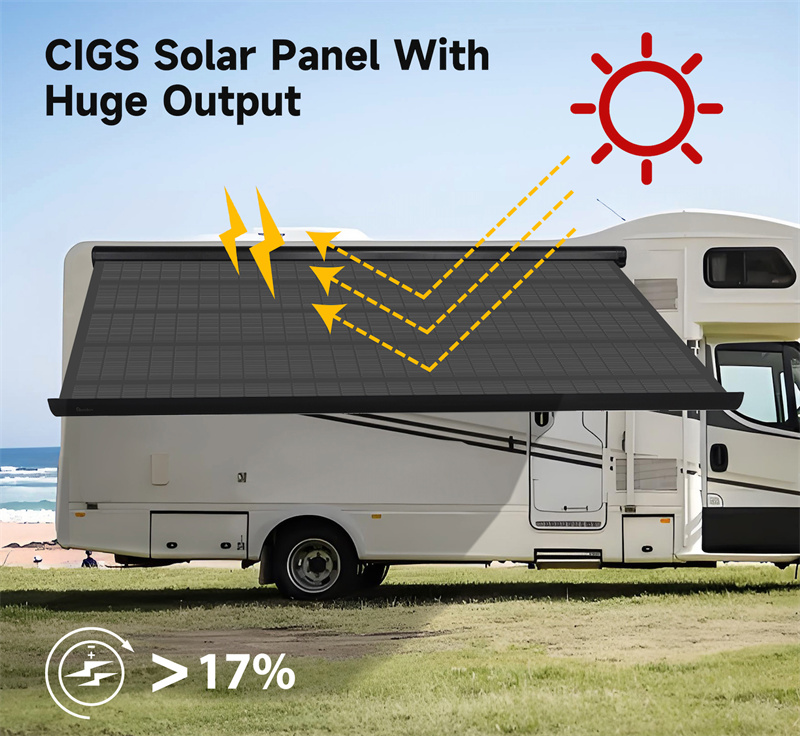
Key Technical Specifications
|
Specification |
Details |
|
Solar Technology |
Flexible CIGS Thin-Film Solar Fabric |
|
Power Density |
90–120 W/m² |
|
Typical System Output (8 m²) |
Up to 800 W Peak |
|
Estimated Daily Energy Yield |
Approx. 3.2 kWh/day (based on 5 Peak Sun Hours) |
|
Applications |
RVs, Caravans, Motorhomes & Camper Vans |
|
Structure |
Retractable Flexible Solar Awning System |
Assume an SA5900 Solar Awning measuring 4 m × 2 m, providing an effective solar collection area of 8 m². Using the standard output of 100 W/m², the theoretical maximum power is: 8 m² × 100 W/m² = 800 W
Considering a realistic system efficiency of 80%, the effective rated output becomes: 800 W × 80% = 640 W
Assuming 5 Peak Sun Hours per day, the estimated daily energy production is: 640 W × 5 h = 3,200 Wh/day (3.2 kWh/day)
Under ideal weather conditions, a large solar-powered RV awning like the Awnlux SA5900 can therefore generate approximately 3.2 kWh of electricity per day, providing a reliable source of renewable energy for extended off-grid camping, RV travel, and outdoor adventures.
Does It Meet Real RV Camping Power Needs?
To better understand whether a solar RV awning can support everyday camping, let's compare the estimated daily power generation of the Awnlux SA5900 with the actual energy consumption of common RV camping scenarios.
Based on the previous calculation, a 4 m × 2 m Awnlux SA5900 Solar Awning can generate approximately 3,200 Wh (3.2 kWh) of electricity per day under ideal conditions (5 peak sun hours and 80% overall system efficiency).
The following comparison illustrates how this output matches typical RV power requirements.
|
Camping Scenario |
Typical Electrical Loads |
Estimated Daily Energy Consumption |
SA5900 Daily Solar Generation |
Energy Match |
|
Weekend Off-Grid Camping |
• LED lighting (~20 Wh) |
≈800 Wh/day |
≈3,200 Wh/day |
Generates approximately 4 times the required daily energy, providing ample power while continuously charging the RV battery system. |
|
Long-Distance RV Travel & Remote Camping |
• RV refrigerator |
≈ 2,000–5,000 Wh/day |
≈3,200 Wh/day |
Satisfies most daily electrical needs for typical RV travel. When paired with a battery storage system, surplus solar energy can be stored during the day and used at night or during cloudy conditions. |
The Awnlux SA5900 CIGS Solar RV Awning provides a reliable off-grid energy solution for RV travelers by meeting daily camping power needs, extending battery runtime, and reducing dependence on shore power and generators.
Why Is a Flexible Solar Fabric Solar Awning Better for RV Applications?
1. Ultra-Lightweight Design: Only 1.3kg/m²
Traditional solar panels usually require additional structures such as aluminum frames and mounting brackets, which increase vehicle weight and installation complexity.
The Awnlux SA5900 flexible CIGS solar fabric weighs only 1.3kg/m², making it one of the lightest solutions in its category. This lightweight design reduces vehicle load, simplifies installation, and makes it especially suitable for mobile applications such as RVs, caravans, and motorhomes.
2. Flexible Deployment and Storage
The CIGS flexible solar module supports 360° folding, allowing the solar fabric to extend and retract together with the awning structure. Unlike traditional rigid silicon solar panels, it requires no fixed mounting system and provides greater flexibility for RV energy applications.
3. Durable Solar Fabric for Outdoor Environments

The SA5900 uses a durable solar fabric structure designed for outdoor conditions, offering excellent resistance against wind, water, and harsh environments. It is suitable for coastal camping, desert adventures, and long-distance RV travel.
Meanwhile, CIGS solar technology provides better performance under low-light conditions compared with traditional silicon solar panels, helping maintain more stable energy output in changing weather conditions.
Conclusion: More Than Shade — A Mobile Renewable Energy Solution
As RV travel continues to move toward energy independence and off-grid living, solar awnings are becoming a smarter renewable energy solution. By accurately calculating solar area, peak sunlight hours, and system efficiency, users can better understand whether a solar RV awning meets their power requirements.
With 90–120W/m² power output, lightweight flexible CIGS thin-film technology, and retractable solar awning design, the Awnlux SA5900 CIGS Solar Awning provides both comfortable outdoor shade and continuous clean energy for RV refrigerators, lighting, charging devices, and onboard battery systems.
Learn More About Awnlux SA5900
If you are looking for a solar RV awning that combines shading, protection, and renewable energy generation, the Awnlux SA5900 CIGS Flexible Solar Awning is an ideal upgrade solution.
Explore the latest specifications, available sizes, technical details, and current offers here:
https://www.awnlux.com/full-cassette-solar-awning
Whether you are upgrading your existing RV power system or building a fully capable off-grid camper, Awnlux SA5900 helps you achieve greater energy independence, longer-lasting power, and a more sustainable outdoor lifestyle.
Let sunlight provide not only shade, but also clean energy for every journey.
Get in touch
Table of Contents
- Introduction: How Solar RV Awnings Are Transforming Off-Grid Camping
- How Is Solar RV Awning Power Output Calculated? -Key Factors That Affect Solar RV Awning Energy Generation
- Real-World Power Output of the Awnlux SA5900 and Typical RV Energy Demands
- Does It Meet Real RV Camping Power Needs?
- Why Is a Flexible Solar Fabric Solar Awning Better for RV Applications?
- Conclusion: More Than Shade — A Mobile Renewable Energy Solution