
 EN
 FR
 DE
 JA
 KO
 RU
 ES
 AR
 IT

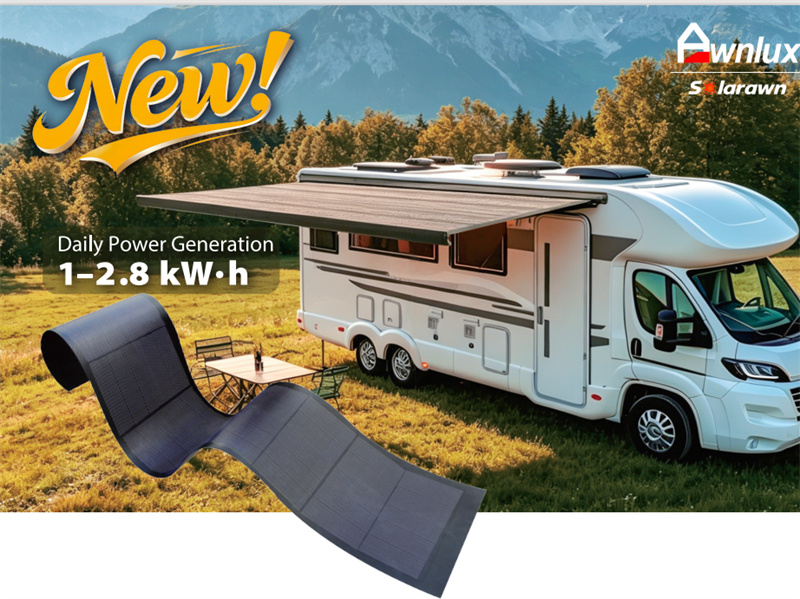
Uncovering low winter sun angles, overcast weak light, and roof snow blackout pain points—with real-world field test data.
|
? Quick Takeaways • Huge Daily Yield Gap: In winter field tests, a 400W CIGS flexible solar awning with an adjustable tilt generated 2.3x more daily energy than 400W of flat roof-mounted monocrystalline panels (and nearly 4x on overcast snowy days). • Snow Doesn't Kill Power: Flat roof panels suffer total power cutoffs (0W output) with just 3%–5% snow coverage. The tilted awning has a 15°–45° pitch that lets snow slide off naturally, maintaining uninterrupted power. • Optimal Sun Alignment: Winter sun stays low, causing sunlight to bounce off flat roof panels. The awning angles down to face the sun directly, drastically reducing light reflection loss. • All-Day Weak-Light Charging: CIGS features a broad absorption spectrum and high weak-light sensitivity. It starts charging earlier at dawn and keeps charging until dusk, delivering an extra 3.5 hours of daily power generation. |
1. Why Do Roof Solar Panels Frequently 'Go on Strike' in Winter?
During winter RV trips or off-grid camping, power consumption surges due to diesel heaters, electric blankets, and onboard appliances. Yet many RV owners discover that hundreds or thousands of watts of rigid roof solar panels barely charge the battery in winter—and drop straight to zero (0W) after a light snowfall. There are three primary reasons:
1. The Sun is Too Low, Grazing Across Flat Roofs: Winter sun hangs low on the southern horizon. Flat-mounted roof panels act like mirrors lying flat, reflecting away most angled sunlight. The actual light captured by the cells is often less than 40%.
2. Snow Coverage = Full String Blackout (The Biggest Headache): Traditional rigid roof panels consist of dozens of silicon cells wired in series. If just a few cells are blocked by snow, the entire panel's current is choked off, cutting power completely. Furthermore, climbing an icy RV ladder in freezing temperatures to scrape snow carries a severe slip-and-fall risk.
3. Weak Light Sensitivity: Silicon Panels Cannot 'Wake Up': Winter is dominated by overcast, foggy, or snowy skies. Traditional monocrystalline panels require strong direct light to trigger charging, leaving them practically dormant on cloudy days.
2. Why Does a CIGS Flexible Solar Awning Solve These Problems?
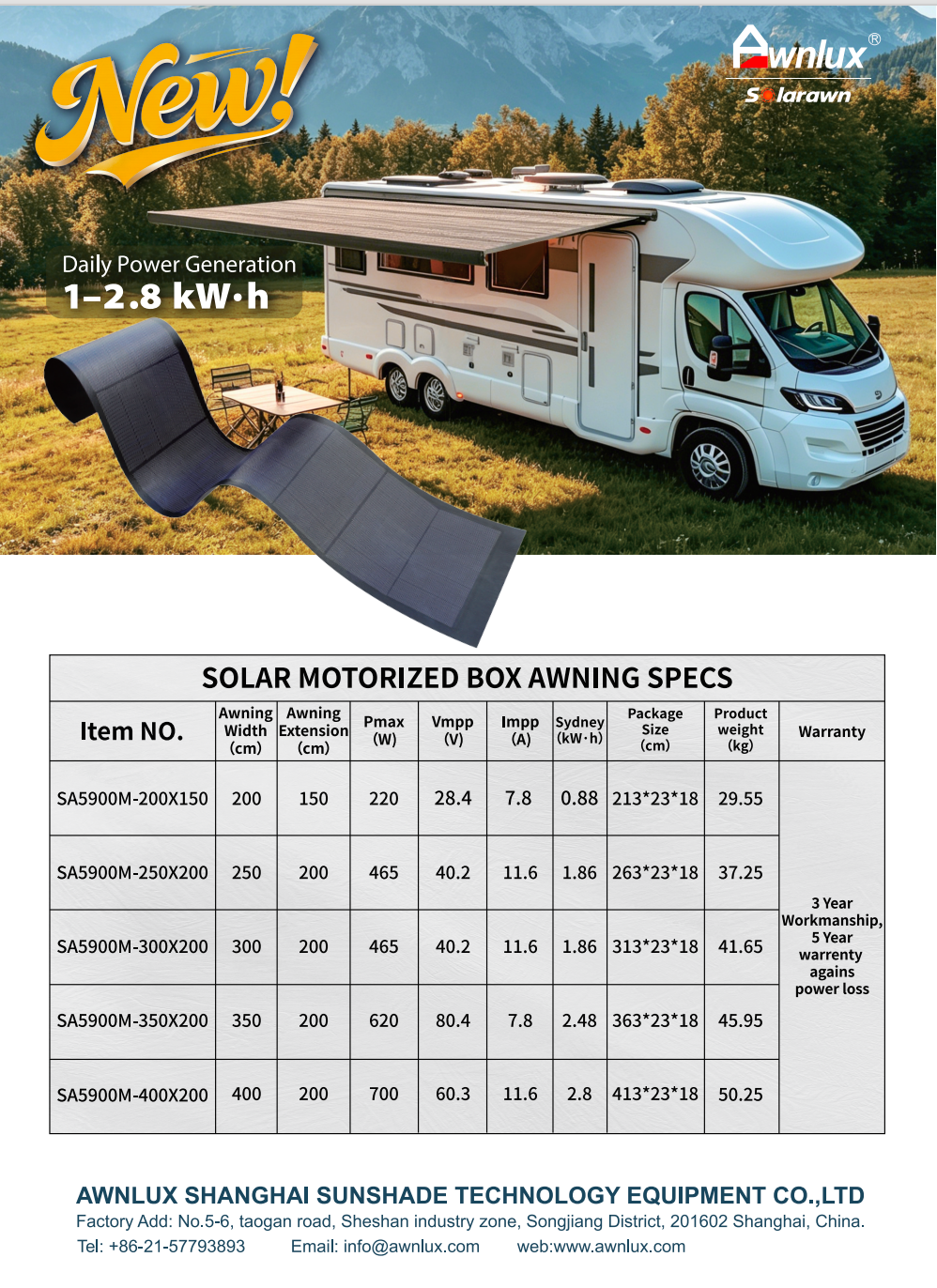
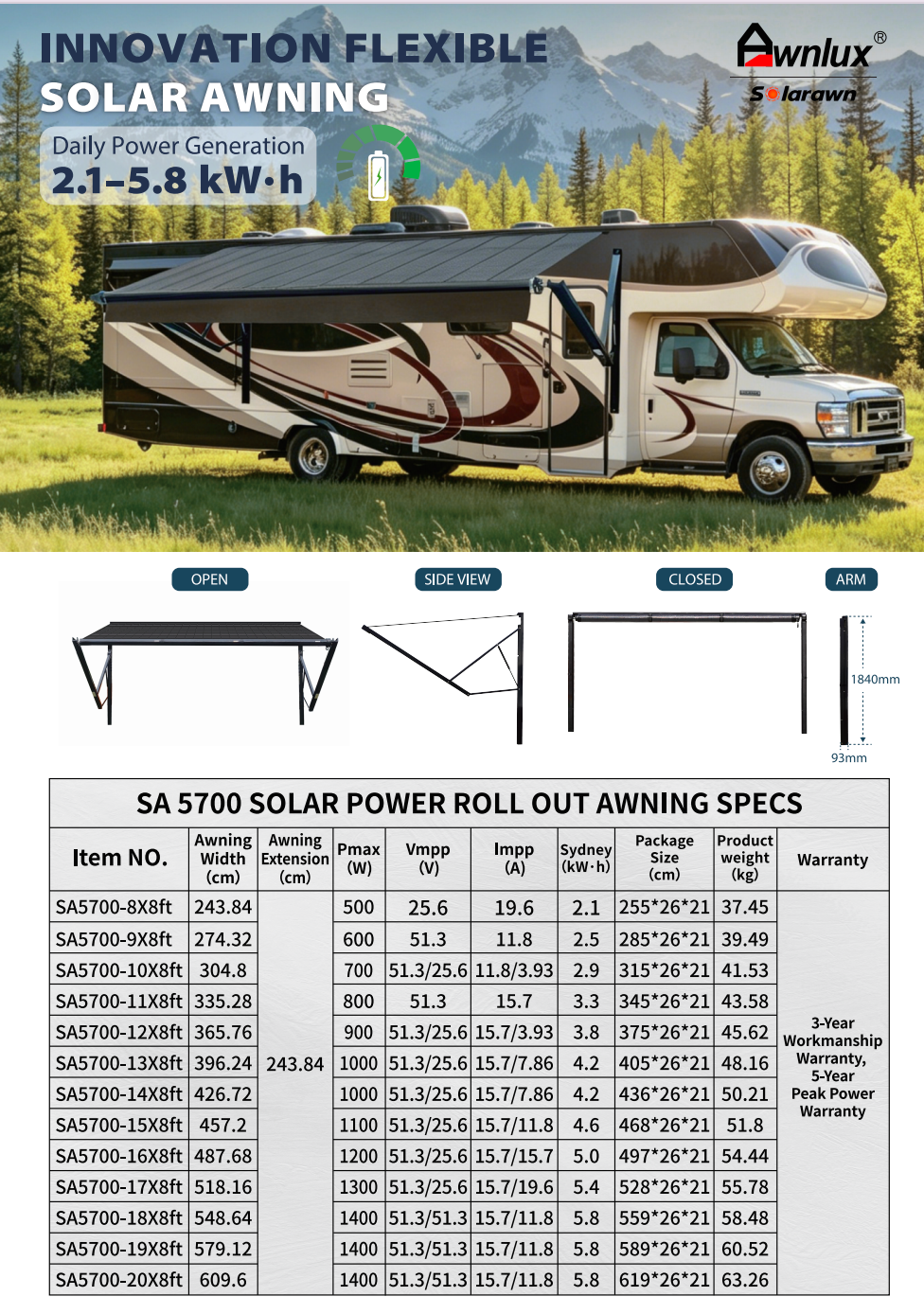
The Awnlux SOLARAWN flexible solar awning seamlessly integrates next-generation CIGS (Copper Indium Gallium Selenide) thin-film solar with a retractable awning structure, offering decisive winter advantages:
• Freely Adjustable Pitch (15°–45°) Directly Faces the Sun: Once parked at camp, simply extend the awning and adjust its pitch to around 35°. It faces directly toward the low winter sun, dramatically boosting light intake.
• Tilted + Smooth Surface: Snow Slides Off Naturally: Because the awning extends at a steep slope with an ultra-smooth, wear-resistant ETFE polymer top layer, fresh dry snow naturally slides down. Even with light wet slush, a quick push-button tap to retract and extend shakes it clean in seconds—no climbing onto the roof required.
• Exceptional CIGS Low-Light Absorption: CIGS thin-film is highly sensitive to diffuse light and infrared rays present on cloudy days. It starts trickle-charging in low twilight at dawn and continues harvesting energy until dusk.
• Partial Shading Doesn't Stop Power Generation: CIGS uses micro-strip patterning. Even if a corner is covered by leaves or residual snow, the remaining clean sections continue generating full proportional power—avoiding the classic rigid panel problem where 'one shaded spot shuts down the entire panel.'
▶ For specific shading test results, check out the Awnlux demonstration video: https://www.youtube.com/watch?v=hKHwNB6uxgA
3. Field Test Benchmark: 400W Awning vs. 400W Flat Roof Panel
Side-by-side test results conducted in a cold high-latitude region (-8°C to +2°C ambient temperature, around the winter solstice) comparing a 400W flat roof monocrystalline panel against a 400W Awnlux CIGS awning (35° pitch):
|
Comparison Item / Real Scenario |
Flat Roof Mono (400W) |
Awnlux CIGS Awning (400W) |
Real Performance Difference |
|
Peak Power Output (Clear Noon) |
148 W |
342 W |
+131% Peak Watts |
|
Active Daily Charge Window |
09:45 AM – 03:15 PM |
07:50 AM – 04:55 PM |
+3.5 Hours More Daily Charge Time |
|
Clear Day Total Yield |
610 Wh / day |
1,420 Wh / day |
2.3x Total Energy Harvest |
|
Overcast / Snowy Day Yield |
110 Wh / day |
430 Wh / day |
Nearly 4x Weak-Light Energy |
|
Next Day After 3cm Snowfall |
0 Wh (Total Blackout) |
1,180 Wh (Snow Sheds, Normal) |
100% Power Uptime Maintained |
|
Snow Maintenance Required |
Risk climbing roof to scrape ice |
Gravity snow shedding / push-button shake |
Zero Slip & Fall Hazard |
4. Frequently Asked Questions
Q: Will freezing temperatures crack the flexible solar film when retracting the awning?
A: Not at all. Awnlux flexible thin-film modules have passed rigorous -40°C extreme cold bending tests. The surface is encapsulated with high-toughness aerospace-grade ETFE, so rolling up or extending in winter will not cause embrittlement or cracking.
Q: My RV already has roof solar panels. Can I still install a solar awning?
A: Absolutely. In fact, this is the most ideal 'dual-zone hybrid setup': in summer when the sun is overhead, flat roof panels handle daily travel charging; in winter or at camp, deploy the solar awning at an angle as your primary power generator, ensuring worry-free electricity all year round.
Q: What should I do in heavy winds or blizzard conditions?
A: The awning can be equipped with an intelligent wind and solar sensor protection system. In severe gale or blizzard conditions, the system automatically detects the weather and retracts the awning into its fully sealed aluminum cassette with a single click, keeping the fabric safe.
Summary: Winter off-grid power freedom doesn't come from blindly stacking more wattage onto flat roofs—it comes from optimal sun angles and weak-light absorption capability. With adjustable tilt, natural snow shedding, and superior diffuse light harvesting, the Awnlux SOLARAWN CIGS flexible solar awning completely solves the winter pain points of snow blackout and cloudy power failure, making winter RV camping much more reliable.
Interested in Awnlux SOLARAWN? Contact Us:
Email: [email protected]
Official Website: www.awnlux.com
Contact Number: +86-21 57793893
Product Demo Videos: https://www.youtube.com/watch?v=Cy1qOOOUZic | https://www.youtube.com/watch?v=PfsZlmWJ3Mo