
 EN
EN
 FR
FR DE
DE JA
JA KO
KO RU
RU ES
ES AR
AR IT
IT
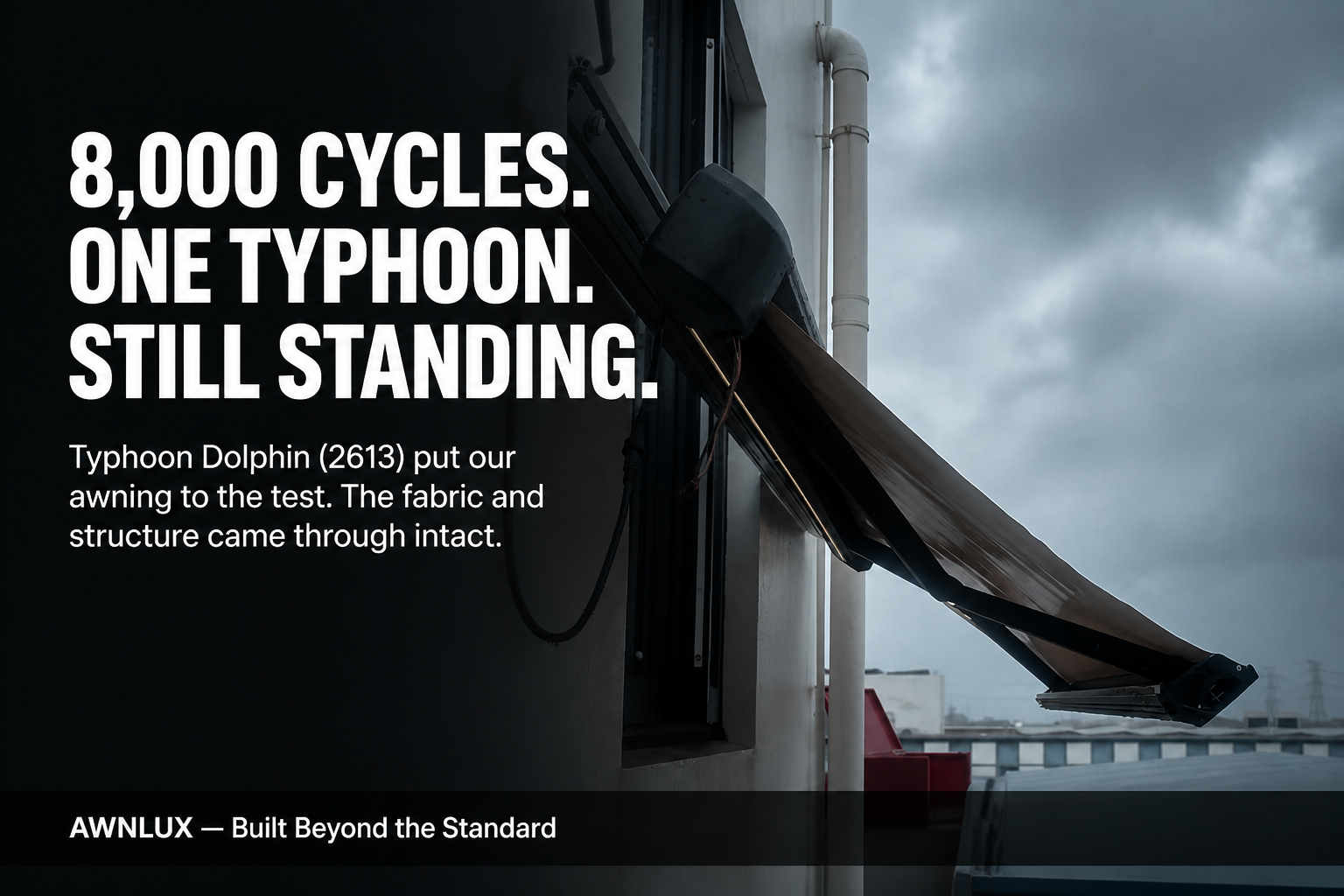
When Typhoon Dolphin hit, our awning was still on the test rack. What happened next wasn't luck — it was engineering.
The Question Every Buyer Should Ask
Before you mount an awning on your RV and hit the open road, ask yourself one question: Has this product ever truly been tested to failure?
Not staged. Not simulated on paper. Actually pushed until something gave way.
Most awning buyers never get a straight answer to that question. At Awnlux, we built our entire quality validation program around making sure we can answer it — with data, with documentation, and in at least one memorable case, with a typhoon.
8,000 Cycles: What That Number Actually Means
The industry standard for awning life testing is well below 8,000 open-and-close cycles. We set our bar higher.
Our validation protocol runs each new product through over 8,000 full deployment and retraction cycles under controlled outdoor conditions. This isn't a lab chamber with artificial UV lamps and a fan — it's a real-world endurance rack, exposed to ambient temperature swings, humidity, and real solar loading.
What we're measuring across those 8,000 cycles:
|
Test Parameter |
What We're Looking For |
|
Motor torque consistency |
No torque degradation across the cycle count |
|
Fabric tension uniformity |
No sagging, puckering, or edge stress cracking |
|
Arm pivot wear |
Smooth articulation with no play or binding |
|
Bracket fastener integrity |
Zero micro-loosening under repeated load cycles |
|
Weatherproof sealing |
Consistent IP-rated motor performance after rain exposure |
By cycle 3,000, weaker products show early signs of arm pivot wear. By cycle 6,000, sub-standard fabric begins to lose its edge seal integrity. We design to pass cycle 8,000 with the same performance envelope it had on cycle one.
The Typhoon That Wasn't in the Test Plan
During the outdoor endurance testing phase of one of our new product lines, Typhoon Dolphin (2613) made landfall.
Our endurance rack was mid-cycle — running continuous open-and-close sequences as it had been for thousands of cycles before. When Typhoon Dolphin made landfall, we did not stop the test.
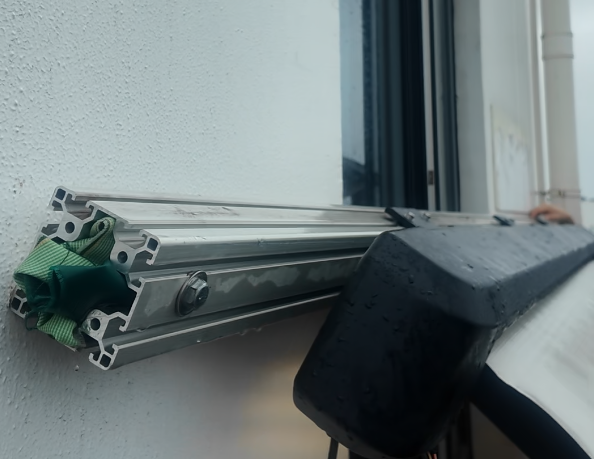
What we observed afterward told us more than any controlled lab session could:
- The awning fabric and arm structure were completely undamaged.
- The wall mounting bracket connection points showed minor loosening.
This outcome is precisely what structural engineering predicts — and precisely what we design for.
The awning itself held. The interface between the product and the vehicle structure — a junction that depends on the installer's hardware, the wall substrate, and the RV body's own flex characteristics — showed the expected stress point.
This is not a failure. This is the system working as engineered.
Why We Set the Wind Rating at Beaufort Scale 5 — and Mean It
We take wind rating specifications seriously enough to publish a number lower than what our competitors claim. Here's why that's the honest position:
Our design specification: Maximum Beaufort Scale 5 (approximately 38 km/h / 21 mph). Retract at Force 6 and above.
An RV awning's real-world wind resistance is not a single-variable equation. It's the product of at least three interacting factors:
1. The awning's structural integrity This is what we engineer and test. Arm geometry, fabric panel load distribution, and motor braking torque are all calculated for defined wind load scenarios.
2. The mounting point's load capacity The bracket transfers all dynamic wind force into the RV sidewall. The wall material, fastener specification, and substrate thickness vary by vehicle. No awning manufacturer controls this variable once the product leaves our facility.
3. The RV body's own dynamic behavior At high wind speeds, the vehicle itself moves. A Type-B motorhome will flex differently than a fifth-wheel trailer. That movement introduces torsional loading into the mounting points that static load calculations don't fully capture.
The cumulative effect of these three variables is why we say:
A wind rating describes the product's structural design ceiling. It is not an operating endorsement for use in high-wind conditions.
When Typhoon Dolphin loosened the mounting connection while leaving the awning itself intact, it confirmed that our design margin is calibrated correctly. The weakest link — by intention — was the adjustable human-installed connection, not the manufactured product.
What It Actually Takes to Build a Reliable Awning
An awning looks simple. Fabric, arms, a motor housing, some brackets. A cutter, a sewing machine, an assembly jig — anyone can put the components together.
The difference between an assembled product and a reliable product is everything that happens before and after assembly.
Our validation process for a new product includes:
- Destructive mechanical testing — we deliberately break samples to establish true failure thresholds, not estimated ones
- High and low temperature cycling — performance verification across the full operational range, including extreme cold startup torque and high-temperature seal integrity
- Vibration and road-shock testing — simulating years of travel over varied road surfaces, including washboard dirt roads and highway expansion joints
- Vehicle integration testing — physical mounting trials on actual RV body types, not just mounting plates in a factory jig
- Road test validation — extended highway runs with the awning retracted and deployed under legal conditions, monitoring for resonance, wind buffeting response, and fastener behavior
All of these tests together answer one question: Will this product still be intact and functional after a decade of real use?
If any single test reveals a deficiency, the product does not advance to production. There are no shortcuts in this sequence.
Reliability Is the Only Metric That Matters on a Moving Vehicle
A solar panel on a rooftop can fail and the consequence is a lost investment. An awning arm that fails at 100 km/h on an open highway is a projectile.
This is not hyperbole. It's the reason we treat every tolerance, every weld, every stitch as a structural decision with real-world consequences.
The RV owner who buys an awning isn't buying shade. They're buying confidence that the product attached to their home-on-wheels will behave predictably under the full range of conditions they'll encounter — from a breezy coastal campsite to an unexpected weather event.
When you see an Awnlux awning extend smoothly for the 4,000th time, or read that a test unit survived a typhoon with its structure intact, you're not seeing luck.
You're seeing 8,000 cycles of evidence.
Specifications & Wind Rating Quick Reference
|
Specification |
Awnlux Standard |
|
Endurance test cycles |
8,000+ open/close cycles |
|
Operational wind rating |
≤ Beaufort Scale 5 (approx. 38 km/h) |
|
Maximum design wind load |
Beaufort Scale 5 |
|
Recommended action at Force 6+ |
Retract immediately |
|
Testing scope |
Destructive, thermal, vibration, road, vehicle integration |
|
Fabric material |
[UV-stabilized, weatherproof technical fabric] |
|
Motor protection rating |
[IP-rated — confirm spec for specific model] |
Final Word
Sixteen years in this industry has taught us one consistent lesson: the customers who stay with us longest are the ones who saw our documentation before they saw our price.
If you're evaluating awnings for your RV — as an OEM fitment, a dealer program, or a direct replacement — we're ready to share the complete test data behind the numbers above.
Because the only awning worth installing is one you never have to think about again.
Interested in product specifications, OEM partnership terms, or dealer inquiry? Contact the Awnlux team !