
 EN
EN
 FR
FR DE
DE JA
JA KO
KO RU
RU ES
ES AR
AR IT
IT
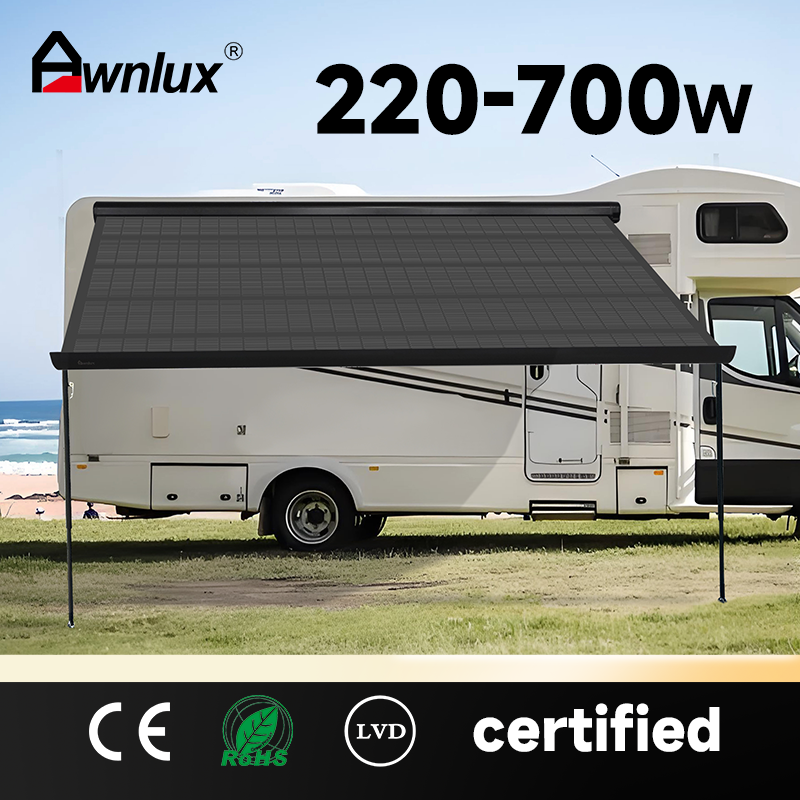
SOLARAWN solar fabric cannot be installed as a direct replacement on a Thule, Fiamma or other conventional awning frame. It requires a dedicated frame system, uses a wall-mounted installation structure, normally comes with MC4 PV connections, and has separate warranty terms for its frame, solar fabric workmanship and power output.
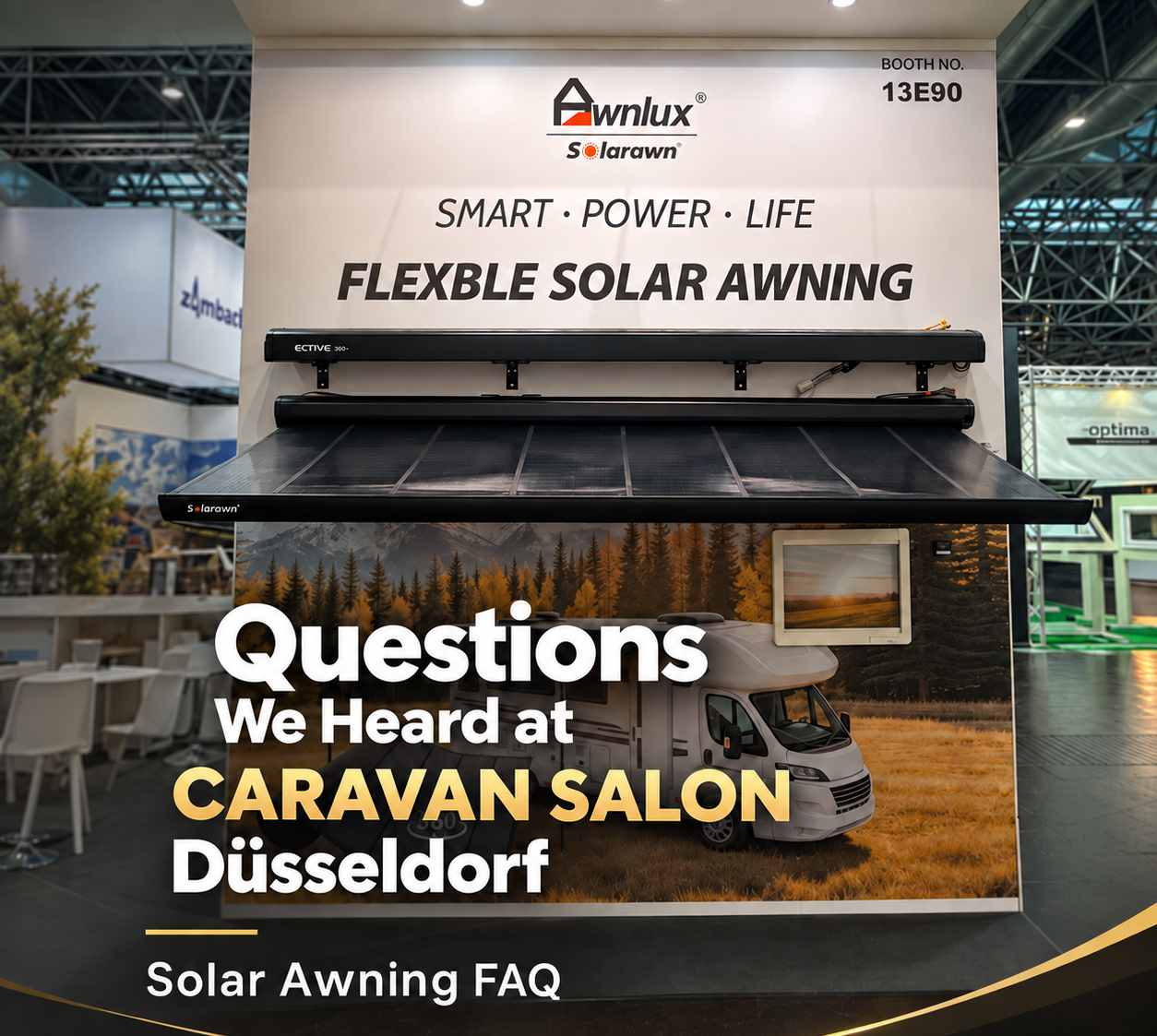
At the German caravan exhibition, visitors were interested in how much electricity a solar awning could generate. However, once the conversation moved from product concept to actual installation, four practical questions appeared repeatedly:
- Can the solar fabric replace the fabric on an existing Thule or Fiamma awning?
- Can the existing mounting brackets be reused?
- What is covered by the warranty?
- Which electrical connectors are supplied, and where do the cables exit?
These questions are important because a solar awning is not simply a conventional awning with a solar panel attached. Its photovoltaic material, mechanical frame, mounting structure and electrical connections must work together as one integrated system.
This guide explains what RV owners, installers, dealers and manufacturers should confirm before selecting or specifying a SOLARAWN system.
Can Solar Fabric Replace the Fabric on a Thule or Fiamma Awning?
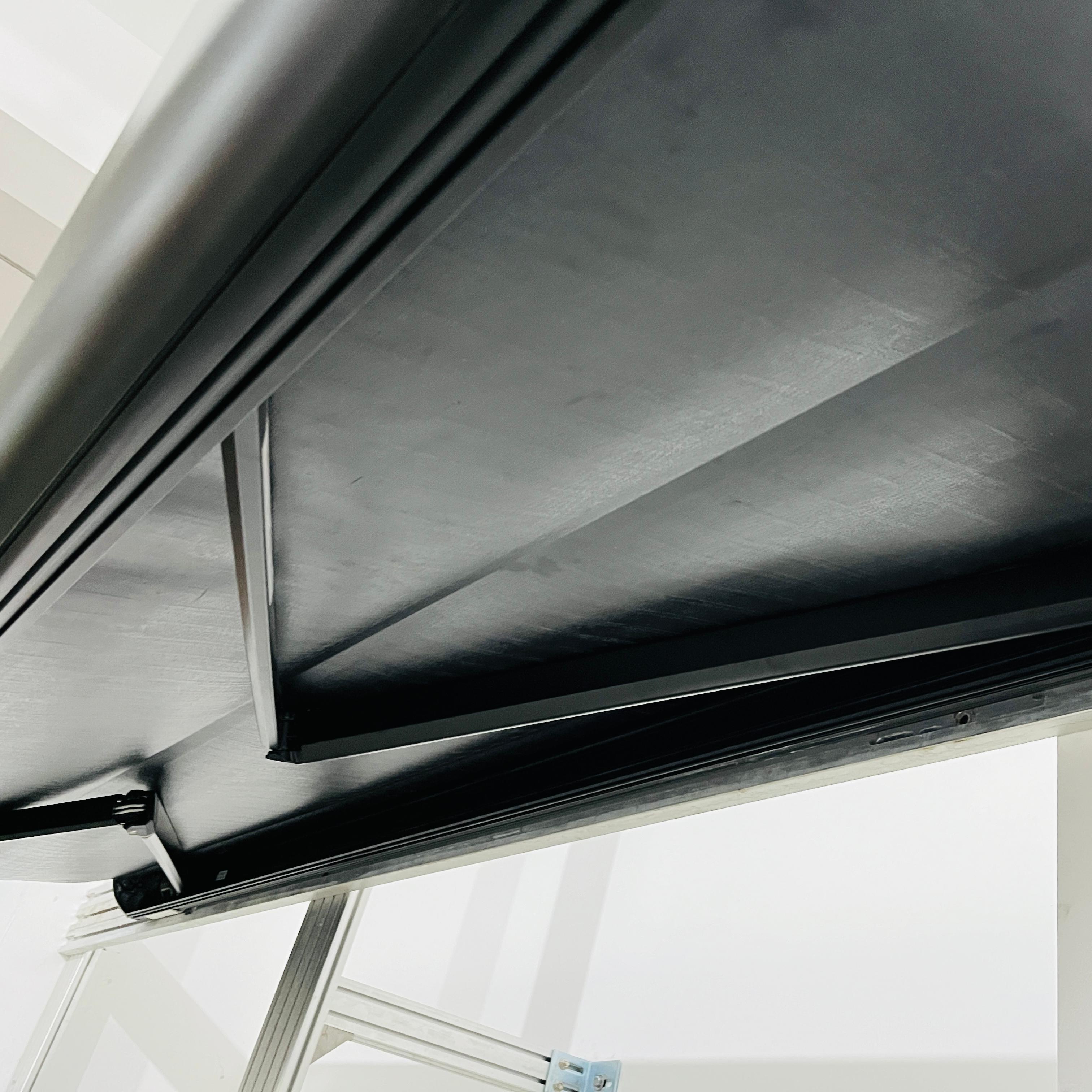
No. SOLARAWN solar fabric is not a drop-in replacement for the fabric on a Thule, Fiamma or another conventional awning.
A normal replacement awning fabric is primarily expected to provide shade and weather protection. Solar fabric must perform those functions while also carrying an integrated photovoltaic layer and maintaining stable electrical performance during extension, retraction and outdoor use.
SOLARAWN uses flexible CIGS photovoltaic technology. The photovoltaic material has an areal mass of approximately 1.3 kg/m² and operates across a temperature range of -45°C to +70°C. Its mechanical and electrical characteristics must be considered as part of the complete awning design.
For this reason, the Awnlux solar awning frame has been developed specifically for the weight and operating requirements of the solar fabric. The frame, arms, legs, front bar and other mechanical components are designed as part of the complete system.
Installing the solar fabric on an unverified frame could introduce several uncertainties:
- The existing frame may not be designed for the weight of the solar fabric.
- The rolling and tensioning geometry may be different.
- The arms and front bar may not provide the required support.
- Cable routing may interfere with normal extension and retraction.
- The original motor and drive system may not have been evaluated for this application.
This does not mean that Thule or Fiamma products are unsuitable as conventional awnings. It means that their frames were not designed or validated by Awnlux as structural platforms for SOLARAWN solar fabric.
What Does This Mean for an RV Owner?
If your existing awning fabric is worn and you only need a replacement canopy, a conventional replacement fabric is the appropriate product category.
If you want to add solar generation through an awning, the project should be evaluated as a complete system installation. The solar fabric and its dedicated frame should be selected together.
Engineering note: A solar awning should be treated as an integrated shade-and-energy system, not as a fabric-only upgrade.
Can SOLARAWN Use Existing Thule or Fiamma Mounting Brackets?
SOLARAWN is a wall-mounted awning, but it cannot be installed directly on existing Thule or Fiamma brackets without a confirmed compatibility solution.
The general mounting concept is similar: the awning is attached to the vehicle wall through mounting brackets or an installation interface. However, similar mounting methods do not mean that the brackets, hole positions or connection profiles are interchangeable.
The Awnlux mounting structure differs from existing Thule and Fiamma systems. If a customer wants to reuse an existing installation position, an appropriate connector or adapter must first be developed and evaluated.
Awnlux is studying connector solutions for these applications. Until a compatible connector has been engineered and confirmed, installers should not assume that an existing Thule or Fiamma bracket can be reused.
Why Can’t Similar-Looking Wall Brackets Be Treated as Interchangeable?
The visible shape of a bracket is only one part of the installation.
A proper compatibility assessment may also need to consider:
- Bracket profile and engagement points
- Hole spacing and fixing positions
- Vehicle wall construction
- Load distribution across the mounting area
- Awning length and total system weight
- Clearance around doors, windows and roof features
- Cable-routing requirements
- Access for installation and future servicing
Two systems can both be described as wall-mounted while still having different mechanical interfaces.
What Information Is Needed for a Fitment Review?
Before Awnlux or an installer can evaluate a vehicle, the following information should be prepared:
- RV or motorhome manufacturer
- Model and production year
- Existing awning brand and model
- Required awning length
- Photographs of the current brackets
- Photographs of the complete installation area
- Vehicle wall construction, if known
- Existing mounting rail or adapter information
- Preferred cable-entry position
- Whether the original brackets will be removed
Awnlux does not publish complete model-to-bracket mappings or proprietary mounting drawings as general installation information. Dealers, RV manufacturers and project customers can contact the Awnlux engineering team for a model-specific fitment review, 3D mounting proposal and quotation.
What Does the SOLARAWN Warranty Cover?
SOLARAWN uses separate warranty periods for the awning frame, solar fabric workmanship and power output.
These warranty categories should not be combined into a single warranty period. A five-year power output warranty, for example, does not mean that every mechanical part carries a five-year warranty.
| Warranty category | Warranty period | Coverage |
|---|---|---|
| Awning frame system | 1 year | Frame-system parts, including components such as the arms, legs and front bar |
| Solar fabric workmanship | 3 years | Workmanship of the solar fabric |
| Power output | 5 years | Power output of no less than 80% under the applicable warranty terms |
| Appearance or electrical issues on receipt | Case review | Assistance or replacement after the issue has been mutually confirmed |
The warranty period starts from the delivery date.
What Is Covered by the One-Year Frame Warranty?
The one-year frame warranty applies to the awning frame system.
If a confirmed warranty issue affects a replaceable frame component, individual parts such as an arm, leg or front bar can be replaced. This serviceable-parts approach can avoid replacing the complete awning when the confirmed problem is limited to one mechanical component.
The specific remedy depends on the nature of the issue and the result of the inspection.
What Does the Three-Year Workmanship Warranty Apply To?
The three-year workmanship warranty applies specifically to the solar fabric.
It should not be interpreted as a three-year warranty for every frame, motor, electrical or mounting component in the complete awning system.
When submitting a claim, the customer or project partner should provide clear photographs, order information and a description of the condition. Electrical or performance-related cases may also require test information.
What Does the Five-Year Power Output Warranty Mean?
The five-year term applies to the power output of the solar fabric, with a warranted output level of no less than 80% under the applicable warranty conditions.
This is a performance warranty. It is separate from the mechanical-frame warranty and the solar fabric workmanship warranty.
Actual solar generation can also be affected by operating conditions such as sunlight intensity, shading, installation angle, temperature, cable configuration and the connected charging system. A low system reading should therefore be diagnosed before it is classified as a solar-fabric performance issue.
What Happens If a Problem Is Found When the Product Arrives?
If the goods are received with an appearance issue or an electrical performance problem, the seller will assist in investigating the issue.
After the condition has been mutually confirmed, the seller will help resolve the problem or provide an appropriate replacement.
Customers should inspect the packaging and product after delivery and retain photographs of any visible transport or product condition.
Which Electrical Connections Are Supplied with SOLARAWN?
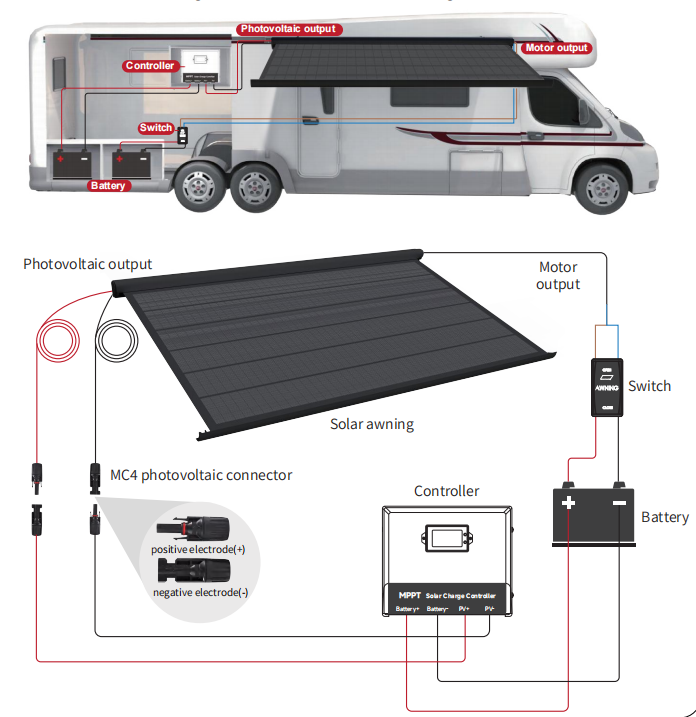
SOLARAWN normally uses MC4 connectors for the photovoltaic connection. Anderson plugs and bare-cable configurations can also be supplied upon request.
| Connection option | Availability |
|---|---|
| MC4 connector | Normally supplied |
| Anderson plug | Available upon request |
| Bare cable | Available upon request |
| Other connector types | Subject to project confirmation |
The selected connector should match the vehicle’s electrical architecture, cable-routing plan and charging equipment.
For OEM, distributor or fleet projects, the connector type should be agreed upon before production. This is particularly important when the awning needs to connect to an existing MPPT controller, solar combiner, battery-charging system or vehicle electrical interface.
Where Are the Motor and PV Cables Located?
The standard cable arrangement is:
| Cable | Standard position |
|---|---|
| Motor cable | Right side |
| PV cable | Left side |
The reference direction should be confirmed in the approved product drawing or order specification.
If a project requires a different cable position, the change must be discussed and confirmed with the supplier before production. Customers should not assume that the internal cable route can be easily reversed after the awning has been manufactured.
Can the Connector or Cable Position Be Customized?
Yes, connector and cable-position requirements can be discussed for a specific project.
The following details should be confirmed before production:
- Required connector type
- Cable length
- Motor cable position
- PV cable position
- Vehicle cable-entry location
- System voltage
- Polarity requirements
- MPPT or controller interface
- Sample, dealer, OEM or production-volume requirements
Providing this information early reduces the need for adapters or wiring modifications during installation.
【 CIGS solar awning technology】
What Should Buyers Confirm Before Ordering a Solar Awning?
Use the following checklist before requesting a quotation or placing an order.
Solar Awning Pre-Order Checklist
- Do I need a complete solar awning or only a conventional replacement fabric?
- What is the brand and model of the existing awning?
- Do I plan to remove or retain the existing mounting brackets?
- Has the vehicle wall and mounting area been assessed?
- What awning length is required?
- Is there enough clearance around doors, windows and roof equipment?
- Is MC4 suitable for the vehicle’s electrical system?
- Is an Anderson plug or bare-cable configuration required?
- Where should the motor cable exit?
- Where should the PV cable exit?
- What controller or charging system will receive the solar input?
- Have I reviewed the separate frame, workmanship and output warranty periods?
- Is a model-specific engineering or 3D fitment review required?
For a one-off installation, a qualified RV technician should assess the mounting surface and electrical routing.
For dealer, distributor and OEM projects, the mechanical and electrical requirements should be documented before sample production.
What Should You Not Assume During a Solar Awning Installation?
A solar awning combines moving mechanical components with a photovoltaic electrical system. Incorrect compatibility assumptions can affect installation, operation and future warranty assessment.
Do Not
- Do not install SOLARAWN solar fabric on a Thule, Fiamma or another unverified awning frame.
- Do not assume that similar-looking wall brackets are mechanically interchangeable.
- Do not drill new mounting holes until the wall structure, bracket position and installation drawing have been reviewed.
- Do not change cable polarity, connector type or internal cable routing without electrical and supplier confirmation.
- Do not interpret the five-year power output warranty as a five-year warranty for every mechanical and electrical component.
- Do not connect the PV output to a battery system without the appropriate charging equipment and electrical protection.
Structural mounting, concealed wiring and solar-system integration should be completed by a qualified installer when the vehicle construction or electrical system is uncertain.
Is SOLARAWN Intended for a New Installation or a Fabric Replacement?
SOLARAWN is best evaluated as a complete new solar awning installation rather than a fabric-only replacement.
| Customer requirement | Suitability |
|---|---|
| Replace worn Thule or Fiamma fabric only | Not suitable as a direct replacement |
| Install a complete solar awning system | Suitable for fitment evaluation |
| Reuse existing Thule or Fiamma brackets | Not directly compatible; connector development and confirmation required |
| Integrate into a new RV model | Suitable for OEM engineering evaluation |
| Develop a repeatable dealer installation | Suitable for model-specific assessment |
| Request MC4 connections | Normally available |
| Request Anderson plug or bare cable | Available upon request |
| Change cable exit positions | Must be confirmed before production |
The correct decision depends on whether the project is a simple fabric-replacement job or a complete mechanical and electrical integration project.
If the objective is only to restore shade protection, conventional replacement fabric is the more direct solution. If the objective is to create additional solar-generating area without permanently occupying more roof space, a complete SOLARAWN system can be evaluated.
How Can Dealers and OEMs Request a SOLARAWN Fitment Review?
Awnlux has focused on RV and vehicle awning engineering and manufacturing since 2010. For model-specific solar awning projects, its engineering team can review the installation conditions before recommending a mounting and connection approach.
To request a fitment review, provide:
- RV or motorhome make, model and year
- Required awning length
- Existing awning brand and model
- Existing mounting-system information
- Installation-area photographs or drawings
- Vehicle wall construction
- Preferred PV connector
- Required cable lengths
- Motor and PV cable exit directions
- Charging-system or controller information
- Estimated sample or annual order quantity
Contact Awnlux to request a model-specific fitment review, connector assessment, 3D mounting proposal and project quotation.
【Contact Awnlux engineering or OEM solutions】
Frequently Asked Questions
Can SOLARAWN fabric replace Thule awning fabric?
No. SOLARAWN solar fabric requires its dedicated frame system and cannot be installed as a direct replacement on a Thule awning frame.
Can SOLARAWN be installed on a Fiamma awning frame?
No. The solar fabric cannot be directly installed on a Fiamma frame. SOLARAWN must be used with its dedicated solar awning frame system.
Can existing Thule or Fiamma wall brackets be reused?
Not directly. Although SOLARAWN is wall-mounted, its mounting interface differs from Thule and Fiamma systems. A compatible connector or adapter must be developed and confirmed before existing mounting conditions can be reused.
Which PV connector normally comes with SOLARAWN?
MC4 is normally supplied. Anderson plugs and bare-cable configurations can also be provided upon request.
Where are the motor and PV cables located?
The standard arrangement places the motor cable on the right and the PV cable on the left. The reference direction should be confirmed in the product drawing or order specification.
Can the connector or cable position be customized?
Yes. Connector type and cable position can be discussed, but all changes must be confirmed with the supplier before production.
What are the SOLARAWN warranty periods?
The awning frame system has a one-year warranty, the solar fabric has a three-year workmanship warranty, and the solar fabric has a five-year power output warranty of no less than 80% under the applicable warranty terms. The warranty period starts from the delivery date.